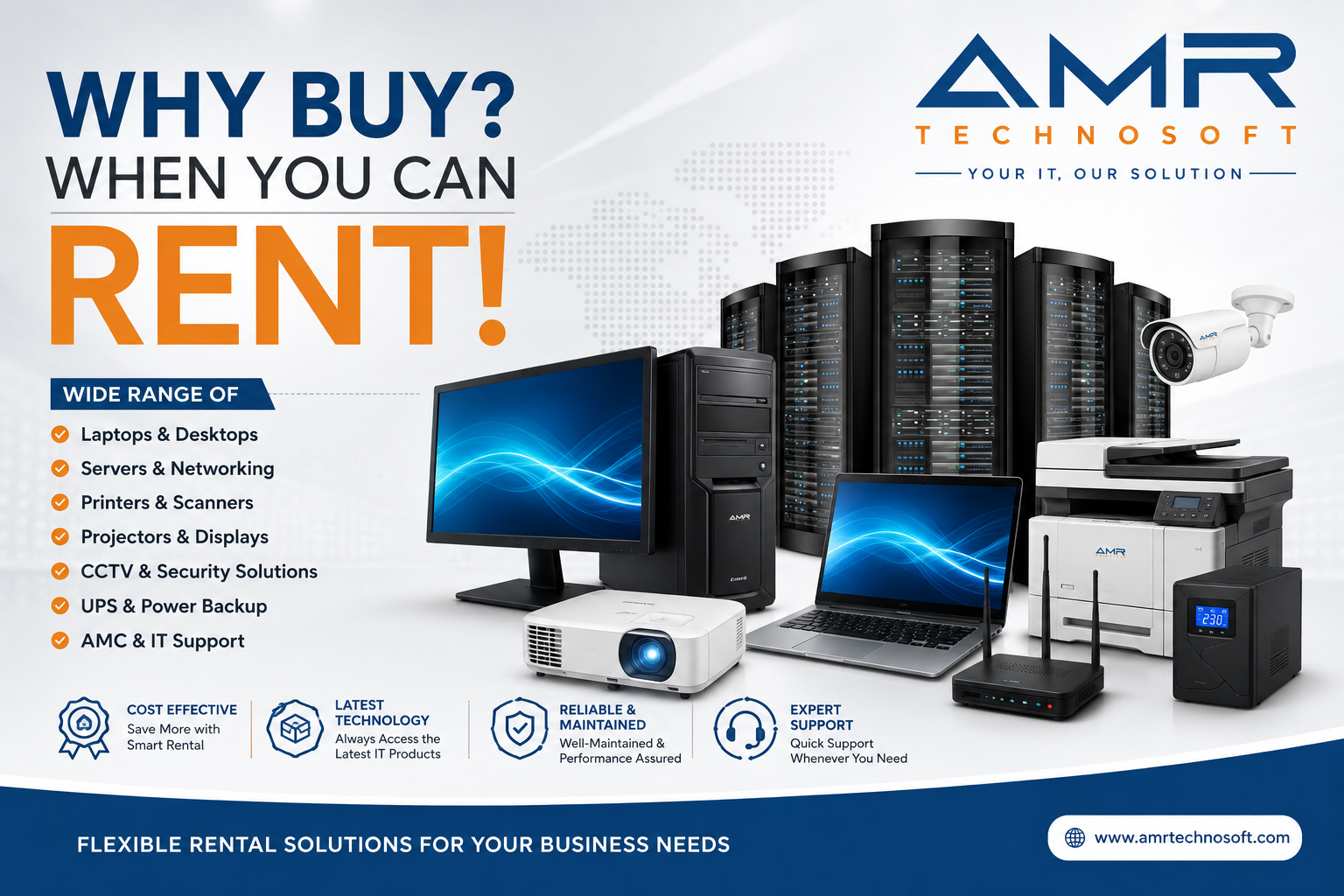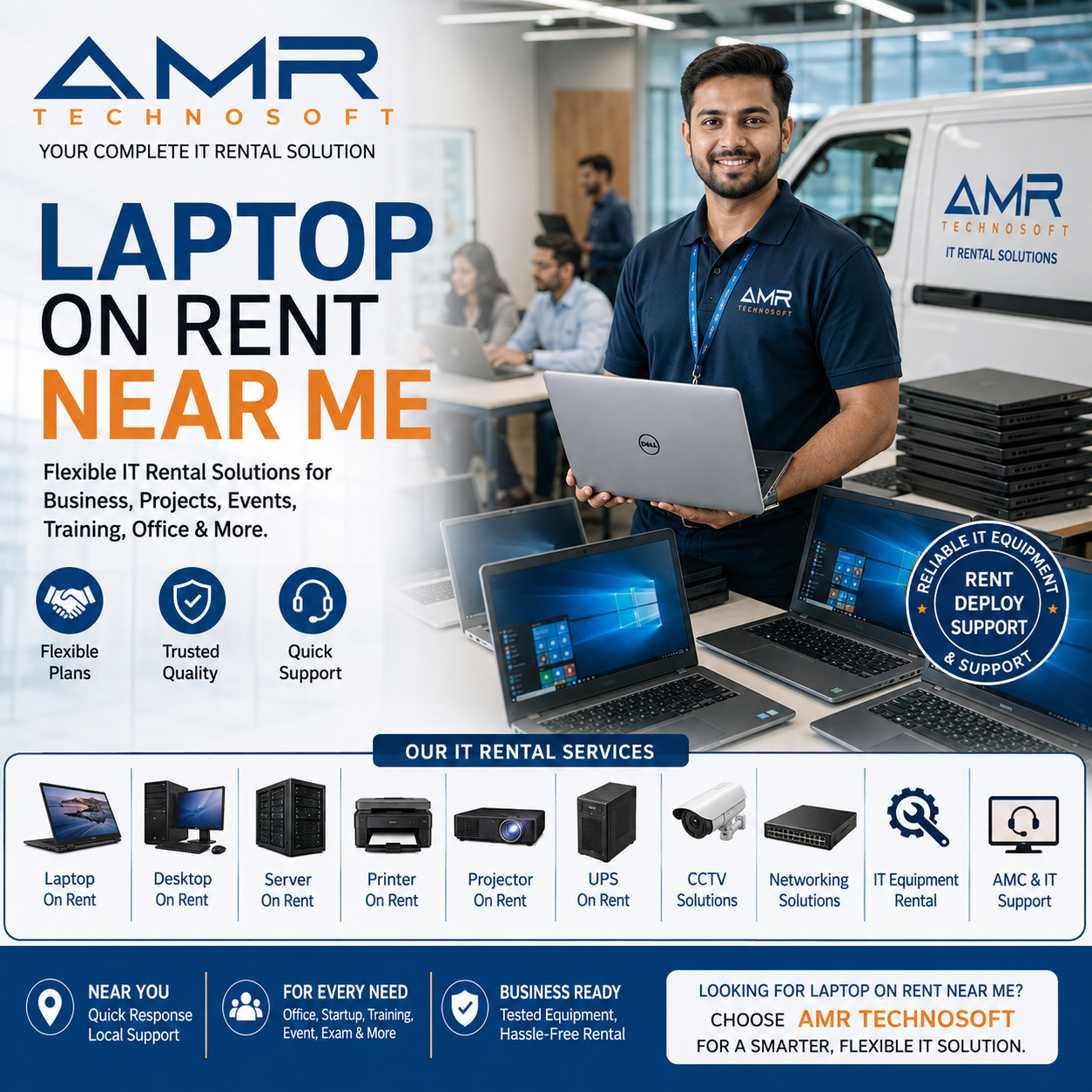
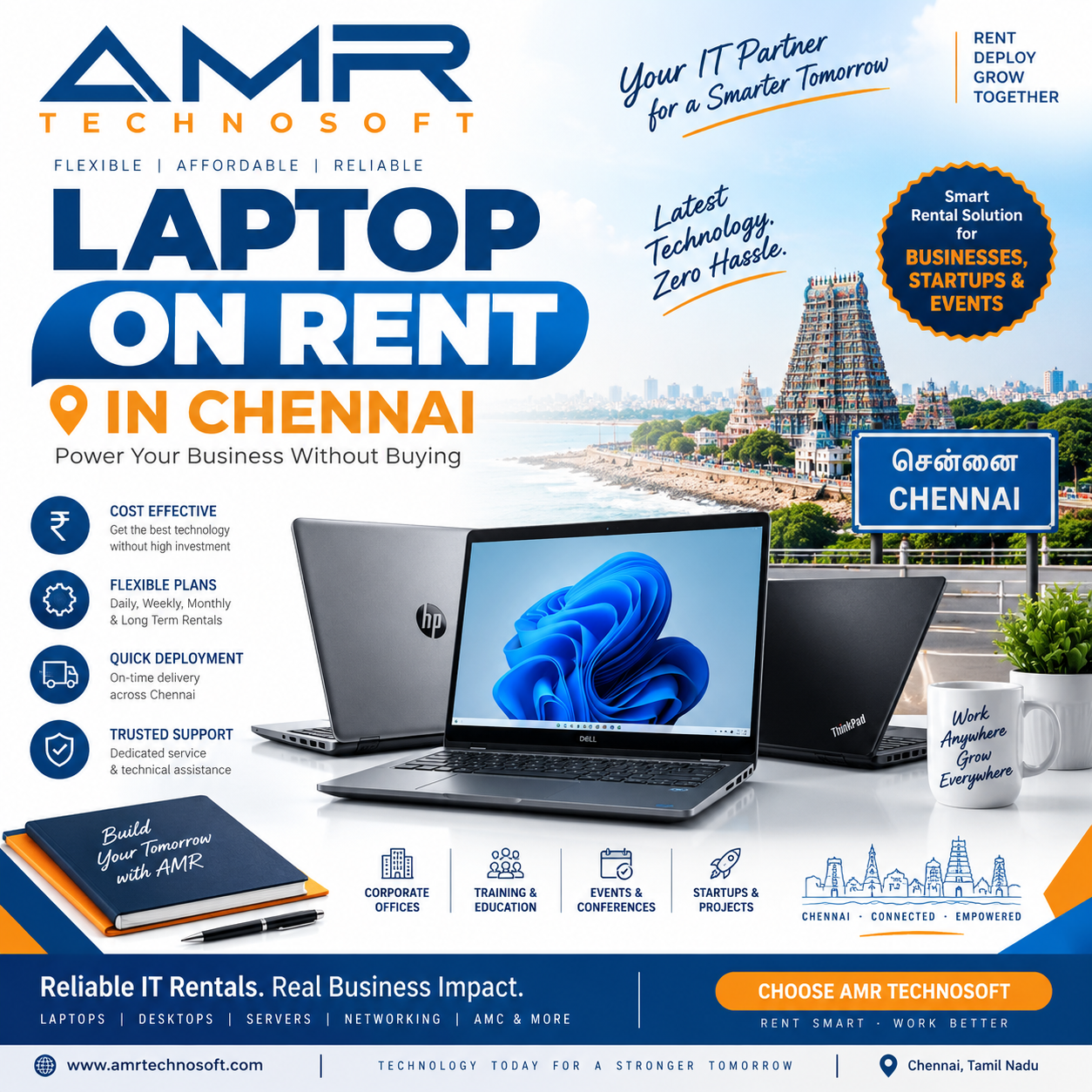
Introduction: Why Laptop Rental Is Becoming Chennai’s Smartest Business Decision – AMR Technosoft Pvt.Ltd.
AMR technosoft is leading servives in Chennai has evolved into one of India’s most dynamic business hubs — a city where IT parks, manufacturing giants, automotive companies, healthcare institutions, educational campuses, and a booming startup ecosystem all coexist within the same metropolitan sprawl. From the tech corridors of OMR (Old Mahabalipuram Road) to the industrial zones of Guindy, Ambattur, and Sriperumbudur, businesses of every size are constantly searching for ways to stay agile, reduce overheads, and scale operations without locking up precious capital in depreciating assets.
Among the many operational decisions a growing business must make, IT infrastructure planning is one of the most consequential — and often one of the most expensive. Laptops, in particular, represent a significant recurring cost. They need to be purchased, configured, insured, maintained, upgraded, and eventually disposed of. For a five-person startup or a five-hundred-person enterprise, that lifecycle consumes time, money, and internal resources that could otherwise be directed toward core business growth.
This is precisely where laptop on rent in Chennai has emerged as a game-changing solution. Rather than committing large sums of capital to purchase computing hardware outright, forward-thinking businesses across Chennai are increasingly turning to laptop rental services to meet their technology needs — flexibly, affordably, and without the long-term burden of ownership.
This comprehensive guide explores everything a business owner, IT manager, HR head, procurement officer, or entrepreneur needs to know about laptop rental in Chennai: why it works, how it works, who it benefits, what to look for in a rental partner, and how it can become a cornerstone of a leaner, smarter, more resilient IT strategy.
Whether you are searching for “laptop on rent in Chennai,” “corporate laptop rental services near me,” “monthly laptop rental for business,” or “bulk laptop hire for events in Chennai,” the principles covered in this guide apply consistently: match hardware to workload, understand the true cost of ownership versus rental, and choose a provider whose service quality matches your business’s operational tempo. By the end of this guide, you should have a clear, practical framework for deciding whether — and how — laptop rental fits into your organization’s broader technology and financial strategy.
Table of Contents
- The Changing Face of Chennai’s Business Landscape
- What Is Laptop Rental and How Does It Work?
- Why Renting Beats Buying: The Core Business Case
- Types of Laptops Available for Rent in Chennai
- Who Benefits Most from Laptop Rental Services?
- Laptop Rental for Startups: Scaling Without the Strain
- Laptop Rental for Small and Medium Enterprises (SMEs)
- Laptop Rental for Large Enterprises and Corporates
- Laptop Rental for IT Companies and Software Development Teams
- Laptop Rental for Events, Conferences, and Training Programs
- Laptop Rental for Educational Institutions
- Laptop Rental for the BFSI and Healthcare Sectors
- Laptop Rental for Remote and Hybrid Workforces
- Short-Term vs. Long-Term Rental Plans: Choosing What Fits
- Cost Comparison: Renting vs. Buying Laptops
- The Hidden Costs of Ownership Nobody Talks About
- How the Laptop Rental Process Works, Step by Step
- Key Features and Specifications You Can Rent
- Customization, Bulk Orders, and Enterprise Rental Solutions
- Technical Support, Maintenance, and Replacement Guarantees
- Data Security and Privacy in Rented Devices
- Sustainability: The Environmental Case for Renting
- What to Look for When Choosing a Laptop Rental Company in Chennai
- Red Flags to Avoid When Selecting a Rental Vendor
- Industries Across Chennai Embracing Laptop Rental
- Laptop Rental vs. Leasing vs. Buying: Understanding the Differences
- Frequently Asked Questions (FAQs)
- Conclusion: Building a Future-Ready Business with Smart IT Choices
1. The Changing Face of Chennai’s Business Landscape
Chennai — often called the “Detroit of India” for its automotive manufacturing dominance — has quietly transformed into a multi-sector economic powerhouse. The city now hosts a thriving IT and ITES sector, a rapidly expanding startup ecosystem, a strong presence of global capability centers (GCCs), robust healthcare and education infrastructure, and a resurgent manufacturing base driven by electronics and EV component makers.
This diversification has created an unusual but powerful demand pattern for IT hardware. A software company in Taramani might need fifty laptops for a three-month project sprint. A wedding-tech startup in Adyar might need twenty laptops for a single event weekend. A pharmaceutical company in Ambattur might need laptops for a two-week compliance audit. A BPO in Perungudi might need to scale its workforce by two hundred seats overnight to meet a client SLA.
None of these situations are well-served by the traditional “buy and depreciate over five years” model of IT procurement. They call for something more elastic — infrastructure that can expand and contract in step with real business needs. That elasticity is exactly what laptop rental delivers, and it explains why the model has grown so quickly across Chennai’s business districts, from the OMR IT corridor to Guindy, Mount Road, Nungambakkam, Porur, and beyond.
Add to this the post-pandemic normalization of hybrid and remote work, the rise of project-based and gig-based business models, and the increasing pressure on companies — especially startups — to preserve cash runway, and it becomes clear why laptop rental in Chennai isn’t a passing trend. It’s a structural shift in how businesses think about technology procurement.
2. What Is Laptop Rental and How Does It Work?
At its core, laptop rental is a service model where a business pays a periodic fee — typically monthly — to use a laptop (or a fleet of laptops) owned and maintained by a rental provider, instead of purchasing the hardware outright. The rental company handles procurement, configuration, delivery, ongoing maintenance, and eventual replacement or upgrade of the devices.
The relationship is refreshingly simple:
- The business identifies its requirement (number of laptops, specifications, duration).
- The rental provider quotes a plan based on configuration and tenure.
- Devices are delivered, configured, and set up — often within 24 to 48 hours in Chennai.
- The business uses the laptops for the agreed period, whether that’s one week, three months, or three years.
- At the end of the term, the business can return the devices, extend the rental, upgrade to newer models, or in many cases opt to purchase the used devices at a residual value.
This arrangement removes the business from the entire hardware lifecycle — no need to worry about warranty claims, component failures, driver updates, disposal compliance, or resale value. The rental company absorbs that operational burden, allowing the business to treat laptops the way it treats electricity or internet connectivity: an operational utility, paid for as it’s consumed.
3. Why Renting Beats Buying: The Core Business Case
The decision to rent rather than buy laptops is rarely about any single factor — it’s about a cluster of financial, operational, and strategic advantages that compound over time. Let’s break down the core arguments.
3.1 Capital Preservation
Every rupee spent on outright laptop purchases is a rupee that isn’t available for hiring, marketing, product development, or working capital. For startups operating on limited runway, and even for established SMEs managing tight quarterly budgets, tying up capital in depreciating hardware is often an inefficient use of scarce resources. Renting converts a large, lumpy capital expenditure (CapEx) into a smooth, predictable operating expense (OpEx) — a shift that finance teams and CFOs consistently favor because it improves cash flow visibility and preserves liquidity for growth-critical activities.
3.2 Predictable, Budget-Friendly Costs
When you rent, you know exactly what you’re paying each month. There are no surprise repair bills, no unplanned replacement costs when a laptop’s motherboard fails eighteen months after purchase, and no need to build a hardware contingency fund. This predictability is invaluable for financial planning, especially for businesses that are scaling, raising funding, or operating on thin margins.
3.3 Always Up-to-Date Technology
Technology moves fast. A laptop that feels cutting-edge today can feel sluggish within two to three years as software demands increase. Businesses that purchase hardware outright often find themselves stuck with aging machines because replacing them mid-cycle feels wasteful. Rental models solve this by making upgrades a built-in part of the service — many providers in Chennai offer refresh cycles that let you swap out older devices for newer configurations as your contract renews.
3.4 Scalability on Demand
Business needs are rarely static. A company might need ten laptops today and fifty next quarter after a funding round or major client win — or it might need to scale down after a project wraps up. Renting allows headcount-linked hardware scaling without the friction of procurement cycles, resale headaches, or idle inventory sitting in a storeroom.
3.5 Reduced Administrative Burden
Owning laptops means owning a whole set of secondary responsibilities: tracking warranties, coordinating repairs, managing insurance, handling asset depreciation in accounting books, and eventually navigating e-waste disposal regulations. Rental providers absorb virtually all of this administrative load, freeing internal IT and HR teams to focus on higher-value work.
3.6 Business Continuity and Reduced Downtime
When a purchased laptop breaks down, the business usually has to source a replacement, wait for repairs, or scramble to reallocate hardware from elsewhere — all of which cause downtime. Reputable rental providers offer swift replacement guarantees, often delivering a working substitute within hours, which keeps teams productive and minimizes the cost of idle employees.
3.7 Tax and Accounting Efficiency
Rental payments are typically treated as a straightforward operating expense, which can simplify accounting and, depending on applicable tax rules, offer efficient treatment compared to depreciating a capital asset over several years. (Businesses should always consult their chartered accountant for specifics relevant to their situation, but the general principle of OpEx simplicity holds broadly true.)
4. Types of Laptops Available for Rent in Chennai
One of the most attractive aspects of the modern laptop rental ecosystem in Chennai is the sheer breadth of configurations available — there is no one-size-fits-all approach. Rental providers typically maintain diverse inventories to serve very different use cases.
4.1 Entry-Level / Basic Configuration Laptops
Ideal for administrative work, data entry, customer support, back-office operations, and general productivity tasks. These typically feature mid-range processors (Intel Core i3 or equivalent), 8GB RAM, and SSD storage — more than sufficient for email, spreadsheets, browser-based applications, and light multitasking.
4.2 Mid-Range Business Laptops
Suited for roles that demand more processing power — project managers, analysts, marketing teams, and general corporate staff who run multiple applications simultaneously. These usually come with Intel Core i5 or i7 processors, 16GB RAM, and larger SSD storage, balancing performance with cost efficiency.
4.3 High-Performance Laptops for Developers and Engineers
Software development, coding, testing, and DevOps work require serious horsepower. Rental fleets for this segment typically include Intel Core i7/i9 or equivalent AMD Ryzen processors, 16GB to 32GB RAM, fast NVMe SSDs, and sometimes discrete graphics cards for compilation-heavy or virtualization-heavy workloads.
4.4 Workstation-Grade Laptops for Design and Engineering
For CAD design, 3D modeling, video editing, animation, and engineering simulation work (common in Chennai’s automotive and manufacturing ecosystem), rental providers offer workstation-class laptops with dedicated GPUs (NVIDIA Quadro/RTX series), high-resolution color-accurate displays, and 32GB+ RAM configurations.
4.5 MacBooks for Rent
Design agencies, media production houses, and certain software teams standardize on macOS. Many Chennai rental providers now stock MacBook Air and MacBook Pro models to serve this specific niche, particularly for creative studios in areas like Nungambakkam and Alwarpet.
4.6 Lightweight, Portable Laptops for Events and Travel
For conferences, exhibitions, roadshows, and short-term events, ultra-portable, lightweight laptops with long battery life and quick setup are preferred. These are optimized for presentations, registration desks, and mobile point-of-sale style use cases.
4.7 Ruggedized Laptops for Field and Industrial Use
Manufacturing plants, logistics hubs, and field service teams sometimes require laptops that can withstand dust, minor drops, and challenging environmental conditions. Specialized rental fleets include semi-rugged or fully rugged laptops built for these demanding settings.
5. Who Benefits Most from Laptop Rental Services?
The honest answer is: almost every category of organization can find value in laptop rental, but some benefit especially profoundly. Let’s examine the primary beneficiary segments in more depth.
- Startups navigating unpredictable growth trajectories and limited funding runways.
- SMEs balancing operational efficiency with tight budgets.
- Large enterprises managing seasonal workforce fluctuations, project-based teams, or short-term contractor engagements.
- IT and software companies running client projects with defined start and end dates.
- BPOs and call centers that scale headcount rapidly in response to client contracts.
- Event management companies needing large batches of laptops for short bursts.
- Educational institutions running training programs, computer labs, or certification courses.
- Healthcare and BFSI organizations with compliance-driven, temporary, or audit-related hardware needs.
- Government and PSU-linked projects requiring hardware for time-bound initiatives.
- Remote and hybrid teams where employees are distributed and hardware needs to be delivered directly to homes across the city or the country.
Each of these categories has distinct pain points that rental addresses in a tailored way — and we’ll explore several of them in detail below.
6. Laptop Rental for Startups: Scaling Without the Strain
Startups live and die by their ability to extend runway and move fast. In the earliest stages, every rupee counts, and founders are constantly weighing trade-offs between hiring, product development, marketing, and infrastructure.
Buying laptops outright for a growing team means locking capital into assets that depreciate rapidly and may become mismatched to the team’s needs within a year. A startup that hires five engineers this quarter and needs fifteen more next quarter after a funding round faces a stark choice: either over-provision hardware in advance (wasting capital) or scramble to procure devices reactively (causing onboarding delays).
Laptop rental eliminates this dilemma entirely. Founders can onboard new hires with fully configured laptops delivered within a day or two, scale down gracefully if a project ends or a role is eliminated, and avoid the awkward, time-consuming process of reselling used laptops when the company outgrows its original hardware.
For Chennai’s booming startup scene — spanning fintech, SaaS, healthtech, and D2C ventures clustered around Guindy, Perungudi, and the broader OMR corridor — this flexibility isn’t just convenient. It’s often a genuine competitive advantage, allowing lean teams to redirect capital toward the initiatives that actually move the needle: customer acquisition, product iteration, and team building.
6.1 Faster Onboarding, Faster Productivity
New hires can be productive from day one when laptops arrive pre-configured with standard software images, security policies, and access credentials — a process rental providers can standardize and streamline far more efficiently than an internal IT team juggling multiple priorities.
6.2 Investor-Friendly Financial Optics
Investors scrutinize burn rate and capital efficiency closely. A lean balance sheet, unencumbered by depreciating hardware assets, often reflects favorably during fundraising due diligence, signaling operational discipline.
6.3 Flexibility Through Pivots
Startups pivot. A team that starts as a mobile-app-only shop might suddenly need workstation-grade laptops for a new AI/ML initiative. Rental fleets can be swapped and reconfigured far more easily than owned assets can be repurposed or resold.
7. Laptop Rental for Small and Medium Enterprises (SMEs)
SMEs form the backbone of Chennai’s economy, spanning manufacturing, trading, services, and professional firms. For these businesses, the calculus around laptop rental centers on operational efficiency and risk reduction rather than hypergrowth scaling.
Many SMEs operate with lean administrative teams that don’t have the bandwidth to manage IT asset lifecycles in-house. A firm with thirty employees typically doesn’t want to dedicate staff time to negotiating warranty claims, tracking depreciation schedules, or researching the latest hardware specifications every time a laptop needs replacing.
Renting laptops allows SME owners and office managers to offload this entire function to a specialized partner, converting an unpredictable, occasionally disruptive cost center into a smooth, forecastable monthly line item. This is particularly valuable for SMEs that experience seasonal business cycles — for instance, a Chennai-based export trading firm that needs additional staff and hardware during peak shipping seasons, or an accounting firm that scales up temporarily during tax filing periods.
7.1 Avoiding Technology Obsolescence
SMEs that purchase laptops often keep them in service for five, six, or even seven years to justify the initial investment — well past the point of optimal performance. This leads to productivity losses that are hard to quantify but very real: slower software, more frequent crashes, and employee frustration. Rental cycles typically ensure devices stay within a reasonable performance window, generally refreshed every two to three years.
7.2 Simplified Vendor Management
Instead of juggling separate relationships for hardware purchase, repair services, and eventual disposal, SMEs working with a rental partner consolidate all of this into a single point of contact — reducing administrative complexity considerably.
8. Laptop Rental for Large Enterprises and Corporates
Large enterprises might seem like the segment least likely to need rental services, given their typically stronger balance sheets — but in practice, big organizations are often the most sophisticated users of rental models, precisely because they understand asset management economics deeply.
Enterprises frequently rent laptops for specific, well-defined scenarios:
- Project-based teams with defined start and end dates, such as system implementation projects, audits, or client engagements.
- Contractor and consultant deployments, where hardware needs to be provisioned quickly and reclaimed cleanly when the engagement ends.
- Seasonal or campaign-driven headcount surges, such as festive-season sales teams or year-end financial close support staff.
- Geographic expansion, where a company entering the Chennai market for the first time needs to equip a new office quickly without waiting for a full-scale procurement process to be approved through corporate hierarchies.
- Disaster recovery and business continuity planning, where a stock of readily available rental laptops ensures operations can continue if primary hardware is compromised or a facility becomes temporarily inaccessible.
Large enterprises also value the asset tracking, centralized billing, and compliance documentation that established rental providers offer — critical for organizations that must maintain rigorous IT asset registers for audit and governance purposes.
9. Laptop Rental for IT Companies and Software Development Teams
Chennai’s IT and ITES sector, concentrated heavily along the OMR corridor (often nicknamed the “IT Expressway”), Ambattur, and Guindy, represents one of the largest and most consistent sources of demand for laptop rental services.
Software development is inherently project-based. A services company might win a six-month client contract requiring twenty-five developers with specific configurations — perhaps high-RAM machines capable of running multiple virtual machines and containerized environments simultaneously. Once the project concludes, that hardware requirement may simply disappear, or the team may be redeployed to an entirely different client with entirely different technical requirements.
Purchasing hardware for this kind of fluctuating, client-driven demand is inefficient at best and financially reckless at worst. Rental arrangements let IT companies match hardware provisioning precisely to active project needs, billing rental costs directly against project budgets in many cases — a level of cost transparency that purchased assets simply can’t offer.
9.1 Client-Specific Configuration Requirements
Many enterprise clients mandate specific security configurations, encryption standards, or even specific hardware brands for contractor-provided equipment. Rental providers with flexible sourcing can meet these bespoke requirements far more nimbly than internal procurement processes bound by standard corporate hardware catalogs.
9.2 Bench Resource Management
IT services companies often maintain a “bench” of employees between projects. Rather than issuing owned laptops to bench employees (creating idle asset costs) or leaving them without equipment, rental provides a flexible middle ground — lightweight rentals that can be scaled up the moment a bench employee is staffed onto a new project.
10. Laptop Rental for Events, Conferences, and Training Programs
Chennai hosts a constant calendar of trade exhibitions, corporate conferences, product launches, hackathons, and training bootcamps — particularly around venues in the Chennai Trade Centre area, major hotel convention halls, and university campuses. These events share a common hardware challenge: they need a large number of laptops for a very short duration, often just a few days.
Purchasing laptops for a three-day exhibition makes no financial sense whatsoever. Renting is the obvious and overwhelmingly popular solution, and Chennai’s rental providers have built entire service lines around fast-turnaround event deployments.
10.1 Registration Desks and Visitor Management
Conferences and trade shows typically need laptops at registration counters for check-in, badge printing, and visitor data capture — usually for the event’s duration only.
10.2 Hackathons and Coding Bootcamps
Educational bootcamps and corporate hackathons often need dozens of identically configured, development-ready laptops delivered to a venue, set up, and collected again within a tight timeframe — a logistics challenge that specialized rental providers are well-equipped to handle.
10.3 Training and Certification Programs
Corporate training sessions, software certification courses, and skill-development workshops frequently require temporary computer labs. Rental laptops, pre-loaded with required software, allow training institutes and corporate L&D departments to run these programs without maintaining permanent hardware inventories that sit idle between sessions.
11. Laptop Rental for Educational Institutions
Chennai’s dense concentration of engineering colleges, business schools, and coaching institutes creates another strong use case for laptop rental. Institutions running short-term certificate programs, entrance exam coaching with computer-based testing components, or supplementary computer labs for specific courses often find it more economical to rent rather than build out permanent computer labs that may only see partial utilization across the academic calendar.
Rental also helps institutions keep pace with evolving curriculum requirements — for instance, a college introducing a new AI/ML elective for a single semester can rent appropriately specced laptops for that cohort rather than making a long-term capital investment in lab infrastructure that may need to change again within a few years as the curriculum evolves.
12. Laptop Rental for the BFSI and Healthcare Sectors
Banking, financial services, insurance (BFSI), and healthcare organizations in Chennai operate under strict regulatory and compliance frameworks, and their hardware needs often reflect this — audits, temporary compliance projects, and short-term regulatory initiatives all generate bursts of hardware demand that don’t justify permanent asset purchases.
12.1 Audit and Compliance Projects
Statutory and internal audits frequently require dedicated, secure hardware for auditors working on-site for a defined engagement period. Rental laptops, configured with appropriate security controls, are commonly used for exactly this purpose.
12.2 Temporary Healthcare Deployments
Hospitals and diagnostic chains expanding into new Chennai neighborhoods, launching vaccination drives, or running temporary health camps often need quickly deployable computing hardware for patient registration and data capture — again, a textbook rental use case given the temporary, location-flexible nature of the requirement.
13. Laptop Rental for Remote and Hybrid Workforces
The shift toward remote and hybrid work has permanently altered how Chennai businesses think about hardware provisioning. When employees work from home — sometimes from across the city, sometimes from other parts of Tamil Nadu or even other states — shipping and managing owned laptops becomes logistically complex.
Rental providers with established last-mile delivery networks can ship pre-configured laptops directly to remote employees’ homes, handle returns when an employee exits the company, and manage replacement logistics without requiring the employee to visit a central office. This “device-as-a-service” approach has become an essential enabler of distributed team models, letting HR and IT departments onboard and offboard remote employees smoothly regardless of their physical location.
13.1 Simplified Offboarding
One of the most underappreciated benefits of rental in a remote-work context is offboarding. When an employee with a company-owned laptop leaves, retrieving the device can be a logistical headache, particularly if the relationship ends on difficult terms. Rental providers often manage the pickup process independently, removing this friction from HR’s plate entirely.
13.2 Standardized Remote Setups
Ensuring every remote employee has an identical, properly secured hardware and software configuration is far easier when a rental provider handles standardized imaging before dispatch, rather than relying on employees to self-configure devices at home.
14. Short-Term vs. Long-Term Rental Plans: Choosing What Fits
Not every business need looks the same, and Chennai’s rental providers typically structure their offerings around a spectrum of tenure options.
14.1 Short-Term Rentals (Days to a Few Months)
Ideal for events, short-term projects, seasonal staffing surges, and temporary contractor engagements. Pricing per day or per week is naturally higher than long-term monthly rates, reflecting the faster turnaround and higher logistics overhead, but the total cost remains dramatically lower than purchasing hardware for a use case that will only last a few weeks.
14.2 Medium-Term Rentals (Three to Twelve Months)
This is a common sweet spot for project-based IT engagements, startup teams scaling through a funding cycle, and SMEs testing out new business lines before committing to permanent infrastructure.
14.3 Long-Term Rentals (One to Three-Plus Years)
For businesses that want the financial benefits of OpEx treatment and hassle-free maintenance without the unpredictability of short-term commitments, long-term rentals offer the lowest effective monthly rates, often including scheduled hardware refresh cycles partway through the contract term.
14.4 Choosing the Right Tenure
The right choice depends on the certainty of the underlying business need. As a general rule: the less certain the duration of the requirement, the more a business should lean toward shorter or flexible-renewal rental terms, even at a slightly higher per-month cost, because the flexibility itself carries value that a marginally lower long-term rate cannot offset if the need disappears unexpectedly.
15. Cost Comparison: Renting vs. Buying Laptops
Let’s walk through a simplified illustrative comparison to understand the financial mechanics (actual figures will vary by configuration, provider, and market conditions, but the structural logic holds consistently).
15.1 The Purchase Scenario
Suppose a business buys a mid-range business laptop outright. The upfront cost includes the device price plus, often, an extended warranty. Over a typical three-year ownership period, the business also absorbs:
- Occasional repair costs not covered by standard warranty (battery replacement, screen damage, keyboard issues).
- Internal administrative time spent managing warranty claims and repair logistics.
- The opportunity cost of capital tied up in the purchase from day one, rather than deployed elsewhere in the business.
- Eventual resale value, which is typically a small fraction of the original purchase price by the time the laptop is retired — often complicated further by the effort required to actually find a buyer.
- E-waste disposal compliance costs and effort if the device isn’t resold.
15.2 The Rental Scenario
In the rental scenario, the business pays a consistent monthly fee that already factors in maintenance, support, and eventual device refresh. There’s no large upfront outlay, no unpredictable repair bill, and no disposal headache at the end of the term — the provider reclaims the device and handles its next lifecycle stage.
15.3 The Real Comparison Isn’t Just Sticker Price
A common mistake businesses make is comparing the monthly rental fee multiplied by 36 months against the one-time purchase price and concluding that buying is “cheaper.” This comparison ignores the substantial hidden costs of ownership discussed above, as well as the strategic value of capital preservation and operational flexibility. When these factors are properly accounted for, rental frequently proves more cost-effective on a true total-cost-of-ownership basis — particularly for businesses experiencing growth, uncertainty, or seasonal fluctuation.
16. The Hidden Costs of Ownership Nobody Talks About
Beyond the direct comparison above, there’s a broader set of hidden costs associated with owning IT hardware that rarely make it into a simple budget spreadsheet but materially affect a business’s operational efficiency.
16.1 Depreciation and Balance Sheet Impact
Owned laptops are capital assets that depreciate over time, and this depreciation must be tracked and reported in financial statements. For businesses without dedicated finance teams, this adds unnecessary accounting complexity.
16.2 Idle Asset Costs
When a project ends or an employee leaves, owned laptops often sit unused in storage, representing capital that’s generating zero return. Multiply this across dozens or hundreds of devices in a mid-sized organization, and the cumulative waste becomes substantial.
16.3 Insurance and Risk Management
Businesses that self-insure their hardware against theft, damage, or loss bear that financial risk directly. Rental agreements often build risk mitigation into the service itself, reducing the business’s direct exposure.
16.4 Internal IT Support Burden
Every owned laptop that malfunctions generates a support ticket that internal IT staff must resolve, often requiring vendor coordination, part sourcing, and repair scheduling — time that could otherwise be spent on strategic IT initiatives rather than break-fix hardware management.
16.5 End-of-Life Disposal and Compliance
India’s e-waste management regulations require proper disposal of electronic equipment, and non-compliance carries both legal and reputational risk. Businesses that purchase hardware directly must manage this obligation themselves; rental providers typically absorb this responsibility as part of their asset lifecycle management.
17. How the Laptop Rental Process Works, Step by Step
Understanding the practical mechanics of renting laptops in Chennai helps businesses plan their procurement timelines with confidence.
Step 1: Requirement Assessment
The business shares its requirements — number of units, configuration specifications, intended use case, delivery locations, and rental duration. A good rental provider will ask clarifying questions to ensure the recommended configuration actually matches the workload (there’s little point renting a workstation-grade laptop for basic data entry, or an entry-level machine for heavy software compilation work).
Step 2: Quotation and Plan Selection
The provider prepares a detailed quotation outlining per-unit monthly (or daily/weekly) pricing, minimum tenure commitments, security deposit requirements (if any), and the scope of included support services.
Step 3: Agreement and Documentation
A rental agreement is signed, specifying terms of use, liability for damage, replacement policies, and end-of-term procedures (return, extension, or purchase option).
Step 4: Configuration and Quality Check
Before dispatch, devices are cleaned, tested, and configured according to the business’s specifications — operating system setup, standard software installation, security policy application, and asset tagging for tracking purposes.
Step 5: Delivery and Setup
In Chennai, reputable providers typically offer delivery within 24 to 48 hours for standard orders, with expedited options available for urgent requirements. For bulk enterprise orders, on-site setup and network configuration support is often included.
Step 6: Ongoing Support
Throughout the rental period, the provider remains the primary point of contact for technical issues, hardware failures, or configuration changes — ensuring the business doesn’t need to build internal expertise for hardware troubleshooting.
Step 7: Term Completion — Return, Extend, or Purchase
At the end of the agreed rental period, the business chooses to return the devices, extend the rental (often at a revised rate reflecting the device’s age), or in many cases, purchase the units outright at a depreciated residual value if they’ve become attached to specific machines.
18. Key Features and Specifications You Can Rent
When evaluating rental options, businesses should think in terms of workload-matched specifications rather than simply choosing the cheapest or most premium option available. Below is a practical framework.
18.1 Processor
- Entry-level (Core i3 or equivalent): Administrative tasks, browsing, email, basic office applications.
- Mid-range (Core i5 or equivalent): General business use, moderate multitasking, video calls, standard business software.
- High-performance (Core i7/i9 or equivalent): Software development, data analysis, video editing, running virtual machines.
18.2 RAM
- 8GB: Suitable for basic productivity work.
- 16GB: The practical standard for most modern business use, comfortably handling multitasking across browsers, office suites, and communication tools.
- 32GB or more: Required for development environments, large dataset analysis, and design/engineering workloads.
18.3 Storage
SSD storage is now the standard expectation even in rental fleets, given the dramatic performance improvement over traditional hard drives. Capacity requirements vary from 256GB for general use to 1TB or more for teams working with large media files or datasets.
18.4 Display and Portability
Business travelers and event staff often prioritize lightweight builds and longer battery life, while design and engineering teams prioritize larger, higher-resolution, color-accurate displays even at the cost of portability.
18.5 Operating System
Windows remains the dominant choice for general business use, while macOS rentals serve creative and certain development teams, and Linux-based configurations are available for specialized engineering and DevOps workloads on request.
18.6 Connectivity and Ports
Businesses with legacy peripheral requirements should confirm port availability (HDMI, USB-A, Ethernet) rather than assuming ultra-modern, port-limited designs will meet their needs — a detail worth clarifying with the rental provider upfront.
19. Customization, Bulk Orders, and Enterprise Rental Solutions
Large-scale hardware deployments come with their own set of considerations beyond simply multiplying single-unit pricing by quantity.
19.1 Standardized Fleet Configuration
For bulk orders, businesses typically want every unit configured identically — same OS image, same security policies, same pre-installed software — to simplify IT support and ensure consistent employee experience. Established rental providers can pre-image devices at scale before dispatch.
19.2 Asset Tagging and Tracking
Enterprise deployments benefit from asset tags and centralized tracking dashboards that let IT and finance teams monitor which devices are deployed where, their rental status, and upcoming renewal or return dates — particularly important for organizations managing hardware across multiple Chennai office locations or even across cities.
19.3 Volume-Based Pricing
Bulk rental orders typically unlock more favorable per-unit pricing than smaller orders, making rental an even more attractive proposition for larger deployments — a dynamic worth negotiating directly with providers when planning sizable rollouts.
19.4 Dedicated Account Management
Enterprise clients often receive a dedicated account manager who handles ongoing requirements, coordinates logistics across multiple delivery points, and serves as an escalation point for support issues — reducing the coordination burden on the client’s internal team.
20. Technical Support, Maintenance, and Replacement Guarantees
The service quality surrounding a rental — not just the hardware itself — is often what separates a good rental experience from a frustrating one.
20.1 Response Time Commitments
Look for providers who commit to clear support response windows, ideally with same-day or next-day resolution for critical issues, particularly in a business-dense city like Chennai where delays can directly translate into lost productivity.
20.2 Replacement Guarantees
A strong rental provider will offer a “dead-on-arrival” or in-service failure replacement policy, ensuring a malfunctioning unit is swapped out quickly rather than leaving the business to manage a lengthy repair process.
20.3 Preventive Maintenance
Some providers offer proactive maintenance check-ins for longer-term rentals, catching potential issues (battery degradation, software performance drift) before they become disruptive failures.
20.4 On-Site vs. Remote Support
Depending on the scale of deployment, businesses should clarify whether support is delivered on-site, via remote troubleshooting, or through a pickup-and-replace model — each has different implications for downtime and convenience.
21. Data Security and Privacy in Rented Devices
A common — and entirely reasonable — concern businesses raise about laptop rental is data security. After all, these devices will handle sensitive company information, and at the end of the rental term, they return to the provider’s inventory for redeployment to another client.
21.1 Data Wiping Protocols
Reputable rental providers follow certified data sanitization standards when a device is returned, ensuring all previous data is irrecoverably erased before the unit is redeployed. Businesses should explicitly confirm this practice — and ideally get it documented in the rental agreement — before signing on with any provider.
21.2 Encryption and Access Controls
Businesses can and should apply their own encryption standards, endpoint security software, and access control policies to rented devices just as they would to owned hardware. Rental doesn’t preclude strong security practices — it simply shifts hardware ownership, not data governance responsibility.
21.3 Remote Wipe and Device Management
For sensitive use cases, businesses can deploy mobile device management (MDM) or endpoint management software on rented laptops, enabling remote wipe capabilities if a device is lost, stolen, or needs to be decommissioned urgently — an especially important consideration for remote workforce deployments.
21.4 Contractual Data Protection Clauses
Rental agreements should include clear clauses addressing data confidentiality, liability in case of a breach, and the provider’s obligations around secure handling of returned devices — points worth reviewing carefully, ideally with legal input for larger enterprise contracts.
22. Sustainability: The Environmental Case for Renting
Beyond the financial and operational arguments, laptop rental carries a genuinely meaningful environmental benefit that increasingly matters to Chennai businesses pursuing ESG (Environmental, Social, and Governance) goals.
22.1 Extended Device Lifecycles
Rental providers (AMR Technosoft)have strong economic incentives to maximize the useful life of each device across multiple rental cycles and clients, rather than seeing a laptop discarded after a single owner’s three-year cycle. This extends the effective lifespan of hardware and reduces the overall volume of electronics manufactured and eventually discarded.
22.2 Responsible E-Waste Management
When devices do reach true end-of-life, established rental providers typically follow certified e-waste recycling protocols — a level of compliance that individual businesses, especially smaller ones, may struggle to manage independently given India’s evolving e-waste regulatory landscape.
22.3 Reduced Manufacturing Demand
Every laptop that gets a second, third, or fourth productive life through rental redeployment is one less new device that needs to be manufactured — reducing the environmental footprint associated with raw material extraction, manufacturing energy consumption, and shipping.
22.4 Supporting Corporate Sustainability Reporting
For businesses tracking sustainability metrics as part of broader ESG commitments, partnering with rental providers who can document responsible lifecycle management practices provides tangible, reportable data points for sustainability disclosures.
23. What to Look for When Choosing a Laptop Rental Company in Chennai
With the laptop rental market in Chennai growing steadily, businesses now have a range of providers to choose from — which makes it important to evaluate potential partners against a clear set of criteria.
23.1 Inventory Depth and Variety
A strong provider maintains a diverse inventory spanning entry-level to workstation-grade configurations, multiple brands, and both Windows and macOS options, ensuring the business isn’t forced to compromise on specifications due to limited stock.
23.2 Delivery Speed and Coverage
Given Chennai’s sprawling geography — from Tambaram in the south to Red Hills in the north, and from the coastal IT corridor to the western industrial belts — delivery reliability across the full metropolitan area (and ideally beyond, for businesses with multi-city needs) is a critical evaluation factor.
23.3 Transparent Pricing
Look for providers who offer clear, itemized pricing without hidden fees for setup, delivery, or standard support — transparency here reduces the risk of budget surprises down the line.
23.4 Service Level Agreements (SLAs)
Formal SLAs covering delivery timelines, support response times, and replacement guarantees give businesses concrete commitments to hold the provider accountable to, rather than relying on informal assurances.
23.5 Client Track Record and References
Providers with an established history serving businesses across various Chennai industries — IT, manufacturing, events, education — bring proven operational maturity that newer entrants may still be developing.
23.6 Flexibility in Contract Terms
The best providers accommodate a range of tenure options, allow reasonable modifications to orders as business needs evolve, and don’t lock clients into inflexible long-term commitments that undermine the very agility rental is meant to provide.
23.7 Value-Added Services
Some providers differentiate themselves by offering complementary services — software licensing support, peripheral rental (monitors, docking stations, printers), on-site IT staffing, or bundled network setup — that can simplify vendor management further for businesses seeking a more comprehensive technology partner.
24. Red Flags to Avoid When Selecting a Rental Vendor
Just as important as knowing what to look for is knowing what to avoid.
- Vague or missing written agreements — verbal assurances about support and replacement policies offer no real protection if disputes arise later.
- Excessive security deposits disproportionate to the hardware value, which can strain cash flow unnecessarily.
- No clarity on data wiping practices — a serious red flag given the security implications discussed earlier.
- Poor communication or slow response times during the sales process itself, which often foreshadows how support requests will be handled once the contract is signed.
- Inflexible minimum tenure requirements that don’t match the business’s actual planning horizon.
- Limited or outdated hardware inventory, forcing compromises on specifications that don’t truly fit the intended workload.
- No physical presence or verifiable business address in Chennai, which can complicate accountability if service issues arise.
25. Industries Across Chennai Embracing Laptop Rental
Laptop rental has found genuine traction across a remarkably wide cross-section of Chennai’s economy:
- Information Technology and Software Services — project-based teams, client engagements, and bench management.
- Business Process Outsourcing (BPO/ITES) — rapid headcount scaling tied to client contracts.
- Automotive and Manufacturing — engineering workstations, plant-floor data capture, and short-term project teams.
- Healthcare and Pharmaceuticals — compliance audits, temporary deployments, and health camp registration.
- Banking, Financial Services, and Insurance — audit engagements and regulatory project teams.
- Education and Training — computer labs, certification courses, and bootcamps.
- Event Management and Exhibitions — registration desks, hackathons, and short-duration deployments.
- Real Estate and Construction — site offices and project-based administrative teams.
- Retail and E-commerce — seasonal staffing surges during festive and sale periods.
- Media and Creative Agencies — MacBook rentals for design, video, and content production teams.
- Startups Across All Sectors — fintech, healthtech, SaaS, D2C, and beyond, all navigating growth with capital efficiency in mind.
This breadth of adoption is itself a strong signal: laptop rental in Chennai isn’t a niche service catering to one type of business — it’s a broadly applicable operational tool that fits naturally into nearly any organization’s technology strategy at some point in its lifecycle.
26. Laptop Rental vs. Leasing vs. Buying: Understanding the Differences
Businesses sometimes conflate rental and leasing, but the two models differ in meaningful ways, and understanding the distinction helps in choosing the right fit.
26.1 Renting
Typically shorter-term, highly flexible, month-to-month or short-tenure agreements with minimal long-term commitment. Best suited for uncertain, fluctuating, or short-duration needs. Includes maintenance and support as standard.
26.2 Leasing
Usually involves longer, fixed-term contracts (often two to five years) with defined end-of-term options (return, renew, or purchase at a predetermined value). Leasing can offer lower monthly rates than short-term rental in exchange for reduced flexibility, and is often better suited to businesses with stable, predictable long-term hardware needs.
26.3 Buying
Full ownership from day one, with all the capital outlay, maintenance responsibility, and eventual disposal burden discussed throughout this guide. Best suited for businesses with very stable, long-term, predictable hardware needs and sufficient capital reserves where the opportunity cost of that capital is genuinely low.
26.4 Making the Right Choice
Many sophisticated businesses in Chennai actually use a blended approach — leasing or buying a core baseline of hardware for stable, permanent roles, while using flexible short-term rental to absorb fluctuating, project-based, or seasonal demand. This hybrid strategy captures the cost efficiency of ownership for predictable needs while retaining the agility of rental for everything else.
26.5 Popular Chennai Localities Where Laptop Rental Demand Is Growing Fastest
Demand for laptop rental isn’t distributed evenly across Chennai — it clusters around the city’s key commercial and industrial corridors, each with its own flavor of hardware requirement.
OMR / IT Corridor (Sholinganallur, Siruseri, Perungudi, Thoraipakkam)
Home to a dense concentration of IT parks, SEZ campuses, and global capability centers, this stretch generates consistent demand for developer-grade and mid-range business laptops, often in bulk quantities tied to client project cycles.
Guindy and Ekkatuthangal
A mixed commercial zone hosting both established IT companies and a growing base of manufacturing and logistics firms, generating demand across the full spectrum from entry-level to workstation-class rentals.
T. Nagar, Nungambakkam, and Anna Salai (Mount Road)
Chennai’s traditional commercial core, home to corporate offices, financial services firms, retail headquarters, and professional services companies — a segment with steady, moderate-volume rental demand often tied to seasonal staffing and short-term projects.
Ambattur and Sriperumbudur (Industrial Belt)
Heavy concentration of automotive, electronics, and component manufacturing units, generating demand for both administrative laptops and ruggedized or workstation-grade devices for engineering and design work.
Porur and Vadapalani
A growing mixed-use commercial zone with expanding IT and services presence, seeing rising rental demand as more mid-sized companies establish offices in the area to take advantage of relatively lower commercial rents compared to the core OMR corridor.
Tambaram and Chromepet (South Chennai)
An expanding hub for educational institutions, coaching centers, and a growing number of satellite offices, driving demand for both training-lab rentals and standard business laptops.
26.6 A Practical Pre-Rental Checklist for Chennai Businesses
Before finalizing any laptop rental order, it’s worth working through a simple internal checklist to ensure the arrangement genuinely fits your needs:
- Have you clearly defined the primary use case for each laptop (administrative, development, design, event use)?
- Have you specified the minimum acceptable configuration (processor, RAM, storage) for each use case rather than defaulting to “whatever is cheapest” or “whatever is most powerful”?
- Have you confirmed the exact rental duration you need, along with flexibility for early return or extension?
- Have you asked the provider about their data-wiping and sanitization protocol for previously used devices?
- Have you clarified the replacement policy and expected turnaround time for a malfunctioning unit?
- Have you confirmed delivery timelines and coverage for your specific Chennai location?
- Have you reviewed the full written rental agreement, including deposit terms, liability for damage, and end-of-term options?
- Have you compared quotations from at least two or three providers to benchmark pricing and service terms?
- Have you checked whether the provider offers bundled services (peripherals, software licensing, on-site support) that could simplify your broader IT setup?
- Have you confirmed billing and invoicing terms, particularly for GST compliance if you’re claiming input tax credit as a registered business?
26.7 Sample Use Case Scenarios: How Chennai Businesses Actually Use Laptop Rental
To make the discussion more concrete, here are a few illustrative (composite, non-specific) scenarios that reflect common patterns seen across Chennai’s business landscape.
Scenario A: A Growing SaaS Startup on OMR
A fifteen-person SaaS startup closes a funding round and plans to double its engineering headcount within two quarters. Rather than purchasing fifteen new high-RAM development laptops outright — a significant capital outlay at an early stage — the founders opt for a twelve-month rental plan, allowing them to onboard new engineers within 48 hours of each hiring decision, and to right-size their fleet if hiring plans shift.
Scenario B: A Three-Day Product Launch Event in T. Nagar
An event management company organizing a three-day product launch and exhibition needs thirty lightweight laptops for registration desks, demo stations, and the media room. A short-term rental, delivered the day before the event and collected the day after, avoids the absurdity of purchasing thirty laptops for a seventy-two-hour requirement.
Scenario C: A Manufacturing Firm’s Six-Month ERP Rollout
A manufacturing company in the Ambattur industrial belt is implementing a new ERP system with the help of an external implementation team. The project requires twenty configured laptops for the consultants and internal project team for the six-month rollout period — hardware that has no ongoing use once the implementation concludes. Renting avoids purchasing devices that would otherwise become surplus inventory the moment the project wraps up.
Scenario D: A BPO Scaling for a New Client Contract
A BPO in Perungudi wins a new client contract requiring eighty additional seats within three weeks. Renting allows the company to meet this aggressive deployment timeline without waiting on a lengthy internal procurement approval cycle for a large capital purchase — and gives them the flexibility to scale back down if the contract doesn’t renew after its initial term.
Scenario E: A Chartered Accountancy Firm During Tax Season
A mid-sized CA firm in Nungambakkam experiences a predictable annual spike in workload during tax filing season, requiring ten additional temporary staff for roughly two months each year. Rather than maintaining ten idle laptops for the remaining ten months, the firm rents devices specifically for this seasonal window, year after year.
26.8 Understanding Rental Pricing Structures
Rental pricing in Chennai’s market typically follows a few common structures, and understanding them helps businesses compare quotations more accurately.
Flat Monthly Rate Per Device
The most common structure, where each unit is billed at a fixed monthly rate based on its configuration tier, regardless of usage intensity.
Tiered Volume Pricing
Per-unit rates decrease as order quantity increases, incentivizing bulk deployments and rewarding businesses that consolidate their hardware needs with a single provider.
Tenure-Linked Discounts
Longer commitment periods typically unlock lower effective monthly rates compared to short-term or month-to-month arrangements, reflecting the reduced logistics and administrative overhead for the provider.
Security Deposits
Many providers require a refundable security deposit, calculated as a percentage of the device value or a fixed amount per unit, returned at the end of the rental term assuming no damage beyond normal wear and tear.
Add-On and Bundled Service Fees
Optional services — expedited delivery, on-site setup, extended warranty-style accidental damage coverage, or peripheral bundles — are often priced separately, so it’s worth requesting an itemized quotation rather than a single all-in figure to understand exactly what’s included.
26.9 Common Myths About Laptop Rental — Debunked
Myth 1: “Rented laptops are old, low-quality, or unreliable.” In reality, established providers maintain rigorously tested, well-maintained inventories, often refreshing fleets on a regular cycle. Quality concerns are far more a function of provider selection than of the rental model itself.
Myth 2: “Renting only makes sense for very short durations.” While short-term rental is a strong use case, many businesses run long-term rental arrangements spanning years, valuing the ongoing maintenance support and refresh cycles just as much as the flexibility.
Myth 3: “Renting is always more expensive than buying over time.” As discussed in the cost comparison sections above, this depends heavily on how comprehensively the total cost of ownership is calculated. When hidden costs of ownership are properly factored in, rental frequently proves competitive or even more economical.
Myth 4: “Data on rented laptops isn’t secure.” Security depends on the practices applied — both the provider’s data sanitization protocols and the business’s own endpoint security measures — not on the ownership model itself.
Myth 5: “Rental is only for large companies with big budgets.” In practice, small businesses and solo entrepreneurs are among the biggest beneficiaries, since rental removes the capital barrier that might otherwise put quality hardware out of reach.
27. Frequently Asked Questions (FAQs)
Q1: How quickly can I get laptops delivered in Chennai?
Most established rental providers in Chennai can deliver standard configurations within 24 to 48 hours for smaller orders, with bulk enterprise orders typically requiring a few additional days for configuration and quality checks, depending on order size.
Q2: Is there a minimum rental period?
This varies by provider, but many offer flexibility ranging from a single day (for events) to multi-year terms (for enterprise deployments). It’s worth clarifying minimum tenure requirements upfront, as some providers impose minimum commitments (often one month) even for shorter perceived needs.
Q3: What happens if a rented laptop breaks down?
Reputable providers offer replacement guarantees, typically swapping a malfunctioning unit within a committed timeframe (often within 24 to 48 hours, sometimes faster for enterprise SLAs) to minimize downtime.
Q4: Can I upgrade my rented laptop’s configuration mid-term?
Many providers accommodate upgrade requests, particularly for longer-term rentals, though this may involve an adjusted monthly rate reflecting the new configuration.
Q5: Is my data safe on a rented laptop?
Data safety depends on both the provider’s data-wiping protocols for previously used devices and the business’s own security practices (encryption, access controls, endpoint management) applied during use. Always confirm a provider’s data sanitization standards before signing an agreement.
Q6: Do rental providers offer both Windows and Mac laptops?
Most established Chennai-based providers maintain inventories spanning both operating systems, though availability of specific MacBook models may be more limited than Windows configurations given typically higher demand-to-supply ratios for Apple hardware.
Q7: Can I eventually purchase a rented laptop?
Many providers offer an end-of-term purchase option at a depreciated residual value, particularly for longer rental terms, though this varies by provider and should be clarified in the initial agreement.
Q8: Is renting more expensive than buying in the long run?
It depends on the true total cost of ownership comparison, factoring in maintenance, depreciation, administrative overhead, and capital opportunity cost — not just the simple sticker price. For many use cases, especially those involving uncertainty, growth, or short duration, rental proves more cost-effective when these factors are properly accounted for.
Q9: Do rental providers deliver across all areas of Chennai?
Coverage varies by provider, so it’s worth confirming delivery capability for your specific location, particularly for businesses in outer suburbs or industrial zones outside the core city limits.
Q10: Can I rent laptops for a single event lasting just a few days?
Yes — short-term, event-specific rentals are a well-established use case, with many providers offering dedicated pricing structures and expedited logistics support for exhibitions, conferences, and training programs.
Q11: What documentation is typically required to rent laptops for a business?
Requirements vary by provider but commonly include business registration documents, GST details, and in some cases a security deposit or advance payment, particularly for new client relationships or larger bulk orders.
Q12: Can rental agreements be customized for enterprise-scale deployments?
Yes — most established providers offer customized master service agreements for enterprise clients, covering volume pricing, dedicated account management, standardized SLAs, and centralized billing across multiple delivery locations.
Q13: What brands of laptops are typically available for rent in Chennai?
Most providers maintain inventories spanning well-known brands such as Dell, HP, Lenovo, and Apple, with availability of specific models depending on current stock levels and demand. It’s worth asking a provider directly about brand preferences if your business standardizes on a particular manufacturer for compatibility or support reasons.
Q14: Can I rent laptops along with other IT equipment, such as monitors, printers, or networking hardware?
Many providers offer bundled rental packages that include peripherals like external monitors, docking stations, keyboards, mice, and even printers or basic networking equipment, which can simplify setup for a temporary office or event significantly rather than sourcing these items separately.
Q15: How does laptop rental pricing compare between short notice and advance booking?
As with most logistics-driven services, booking in advance generally secures better pricing and guarantees stock availability, while last-minute or urgent requests may carry a premium and are more subject to inventory constraints, particularly during high-demand periods such as festive hiring seasons or major event calendars in the city.
Q16: Is GST applicable on laptop rental services, and can businesses claim input tax credit?
Laptop rental services are generally subject to GST, and registered businesses can typically claim input tax credit on rental payments used for business purposes, similar to other business expenses — though businesses should confirm specifics with their accountant or tax advisor and ensure the provider issues proper GST-compliant invoices.
29. Final Thoughts: Why “Renting Smart” Is the New Competitive Advantage
Across nearly every conversation this guide has covered — from startup cash flow to enterprise asset governance, from event logistics to sustainability commitments — one theme recurs consistently: business success today depends less on owning assets and more on having reliable, flexible access to the right resources at the right time. Laptops are no exception.
Chennai’s business community, spanning its IT corridors, industrial belts, educational institutions, and entrepreneurial hubs, has increasingly recognized that the old model of buying hardware and holding onto it until it becomes obsolete no longer serves the pace at which modern organizations need to operate. Laptop rental offers a practical, proven alternative — one that trades the illusion of ownership for the reality of agility, predictable costs, dependable support, and a lighter administrative footprint.
Whether the need is five laptops for a fast-growing startup team, fifty for a short-term project engagement, or five hundred for an enterprise-wide rollout, the fundamentals remain the same: define the requirement clearly, choose a rental partner with a strong track record and transparent terms, and treat computing hardware as the flexible operational utility it has become — rather than a fixed capital commitment that quietly drains resources long after its usefulness has faded.
For businesses across Chennai looking to move faster, spend smarter, and build IT infrastructure that flexes with — rather than constrains — their growth, seamless laptop rental isn’t just a convenient option. It’s fast becoming the default, empowering choice.
30. Quick Reference: Key Takeaways at a Glance
- Laptop rental converts a large, unpredictable capital expense into a smooth, predictable operating expense, freeing up cash for core business priorities.
- Businesses of every size — from three-person startups to thousand-employee enterprises — can find a tenure and configuration that matches their exact needs.
- Rental removes the administrative burden of warranty management, repair coordination, and e-waste disposal from internal teams.
- Employees consistently work on well-maintained, appropriately specified, up-to-date hardware rather than aging owned devices kept in service past their useful life.
- Short-term rentals are ideal for events, audits, and time-bound projects; long-term rentals suit steady-state teams seeking OpEx simplicity and refresh cycles.
- Data security depends on provider sanitization protocols and the business’s own endpoint security practices — both should be verified before signing any agreement.
- Chennai’s diverse economy — IT, manufacturing, healthcare, BFSI, education, and events — has made laptop rental a mainstream, broadly adopted operational choice rather than a niche solution.
- Choosing the right provider comes down to inventory depth, delivery reliability, transparent pricing, clear SLAs, and a demonstrated track record across similar business use cases.
- A hybrid strategy — owning a stable baseline while renting for fluctuating or project-based needs — often delivers the best of both worlds for mature organizations.
28. Conclusion: Building a Future-Ready Business with Smart IT Choices
Chennai’s business environment — fast-moving, diverse, and increasingly project-driven — rewards organizations that treat operational flexibility as a genuine strategic asset rather than a nice-to-have convenience. Laptop rental sits squarely within this philosophy. It converts a traditionally rigid, capital-intensive procurement process into an elastic, service-driven model that flexes in step with real business needs, whether that means scaling a startup team through a funding round, equipping a project-based IT engagement, staffing a three-day exhibition, or supporting a distributed remote workforce spread across the city and beyond.
The benefits extend well beyond simple cost savings, though those are often substantial in their own right. Rental frees internal teams from the administrative burden of hardware lifecycle management, ensures employees consistently work on well-maintained, appropriately specified devices, supports stronger data security practices through proper end-of-life sanitization, and contributes meaningfully to sustainability goals through extended device lifecycles and responsible e-waste management.
For businesses across every sector represented in Chennai’s diverse economy — technology, manufacturing, healthcare, education, events, finance, and beyond — laptop rental offers a genuinely compelling path toward leaner, more agile, more resilient IT infrastructure. As the city’s business ecosystem continues to grow and diversify, the organizations that thrive will increasingly be those that recognize technology procurement not as a fixed, one-time decision, but as an ongoing, adaptable strategy — one where renting, rather than owning, often represents the smarter, more empowering choice.
Whether you’re a startup founder equipping your first team, an HR manager onboarding a wave of new hires, an IT procurement lead managing a multi-location enterprise rollout, or an event planner coordinating a weekend conference, laptop rental in Chennai offers a seamless, scalable, and genuinely business-empowering solution — one built for the way modern organizations actually work.