In 2026, technology isn’t just evolving quickly—it’s evolving ruthlessly. The AI-powered laptops that topped procurement lists in early 2024 are already being outpaced by edge-computing devices. Server setups built for hybrid teams just two years ago now buckle under today’s workloads. What used to take five years to depreciate now happens in under eighteen months. For businesses that own their hardware outright, this relentless obsolescence is quietly eating into budgets.
Despite this, thousands of Indian companies remain tied to the buy-to-own model—sinking large sums into upfront capital, absorbing ongoing maintenance costs, and struggling with disposal of equipment that’s outdated before the warranty even runs out. But there’s a better way forward, and more businesses are catching on.
Renting tech equipment in 2026 isn’t a stopgap measure—it’s a calculated business move. Companies choosing to rent instead of buy are unlocking flexibility, protecting their cash reserves, and gaining access to cutting-edge hardware without the financial baggage that comes with ownership. AMR Technosoft, a leading Tech Rentals Company in India, is helping businesses of all sizes make this transition smoothly and affordably.
This article explores exactly why renting outperforms buying in 2026—covering cash flow advantages, technology lifecycles, scalability, tax benefits, and real business scenarios from across India.
Why Is Renting Tech Equipment Smarter Than Buying in 2026?
Renting tech equipment is the smarter choice in 2026 because it turns a large capital outlay into a predictable operating expense, removes the risk of holding depreciating assets, and ensures continuous access to upgraded hardware—all through one straightforward rental agreement.
The buy-to-own approach worked when hardware changed slowly and companies kept devices for seven to ten years. Those days are gone. Businesses today operate in an environment that demands speed. A startup bringing on forty engineers in a single quarter can’t afford to wait through a three-month procurement cycle. A large enterprise rolling out hybrid work policies can’t justify buying hundreds of devices that may need replacing within two years as AI-native hardware becomes the norm.
Renting removes these obstacles entirely, giving businesses exactly the equipment they need, exactly when they need it, at costs that align with operational budgets—free from the long-term burden of ownership.
How Has Rapid Technology Change Made Ownership Risky?
Fast-moving technology has turned ownership into a liability, since hardware that represents a major investment today may be practically obsolete within 18 to 24 months—leaving owners stuck with depreciated equipment, costly upgrades, and disposal headaches.
Think about how much has shifted since 2022. On-device AI co-processors have reshaped what laptops and desktops are capable of. Cloud-native applications now require hardware that can manage local inference tasks. Laptops bought just three years ago can no longer run many of the productivity tools knowledge workers depend on today. Companies that purchased that hardware outright are now absorbing a double hit: the original cost, plus the cost of early replacement.
The Depreciation Problem Nobody Talks About
Most IT equipment loses 25% to 40% of its value in the first year alone. A laptop priced at ₹80,000 today could carry a book value under ₹48,000 a year later—and its actual functional value drops even further. For companies managing fleets of hundreds or thousands of devices, this depreciation adds up to serious balance sheet damage.
Renting sidesteps this issue completely. The rental provider takes on the depreciation risk. Businesses simply use top-tier hardware, hand it back at the end of the agreement, and move up to the next generation—no write-offs, no disposal hassles, no stranded assets sitting idle.
What Are the Real Cost Differences Between Renting and Buying Tech?
When you calculate the true total cost of ownership—purchase price, maintenance, insurance, IT support, upgrades, and disposal—renting tech equipment typically runs 30% to 50% cheaper than buying over a three-year period for most Indian businesses.
Scenario: A 50-Person Tech Startup in Bengaluru
A 50-person startup buying business-grade laptops outright would face roughly these costs:
- Device purchase: ₹80,000 × 50 = ₹40,00,000 upfront
- Annual maintenance and AMC: ₹3,00,000
- IT support and configuration: ₹1,50,000
- Hardware replacement (failures, damages): ₹2,00,000
Three-year total: approximately ₹57,30,000
That same startup choosing a Laptop Rental solution through a provider like AMR Technosoft would pay roughly ₹3,500 to ₹5,000 per device, per month—covering maintenance, replacements, and technical support included. Across 36 months, that comes to ₹63,00,000 to ₹90,00,000 on paper. But the equation shifts once you factor in the returns generated by reinvesting preserved capital, zero disposal expenses, bundled maintenance, and the ability to swap in newer hardware mid-contract. Taken together, the operational upside and eliminated risk make renting the financially stronger option for most growth-stage companies.
This principle isn’t limited to laptops—it extends to servers, networking equipment, projectors, and full office tech setups. Companies renting IT infrastructure avoid six-figure capital commitments while retaining the flexibility to scale that infrastructure as business needs shift.
How Does Tech Rental Improve Cash Flow and Financial Planning?
Tech rental strengthens cash flow by swapping large, unpredictable capital expenses for fixed, manageable operating costs—making budgets easier to forecast, freeing up working capital, and preserving financial flexibility for investments that matter most.
For startups and SMEs navigating India’s competitive landscape, protecting cash isn’t optional—it’s essential to survival. Every rupee tied up in hardware is a rupee unavailable for product development, hiring, or expansion. CFOs and founders who’ve shifted to scalable IT rental solutions consistently report stronger liquidity and greater confidence in quarterly planning.
Tax Efficiency: OPEX vs CAPEX
Under Indian accounting standards, rental payments count as operating expenses (OPEX), meaning they’re fully deductible in the year they’re incurred. Purchased equipment, on the other hand, falls under capital expenditure (CAPEX) and must be depreciated over several years, delaying the tax benefit. For businesses aiming to lower taxable income in the current financial year, switching to tech equipment rental offers a real tax advantage.
What Types of Businesses Benefit Most from Tech Rentals in 2026?
Startups, SMEs, enterprises with hybrid workforces, project-based teams, and rapidly scaling companies all gain the most from tech rentals in 2026—essentially, any organization that prioritizes flexibility and growth speed over holding fixed assets.
Startups and Early-Stage Companies
A Series A startup in Pune hiring 30 engineers within 90 days can’t afford to burn through runway on hardware purchases. Laptop Rental services let it equip every new hire from day one, with devices delivered, configured, and ready to go—without a single large purchase order weighing down its books.
Enterprises with Hybrid and Remote Teams
Large enterprises managing hybrid teams across multiple cities face a different set of challenges: keeping equipment standardized across locations while handling replacement cycles for thousands of devices. IT rentals let enterprise procurement teams standardize configurations, manage upgrades centrally, and scale their fleet up or down without the complexity of traditional asset management.
Project-Based and Short-Term Teams
Consulting firms, event technology companies, and project-based teams needing equipment for 3 to 12 months have long been stuck with the buy-to-own model, purchasing gear they don’t need long-term. Short-term tech equipment rental solves this directly: rent for the project’s duration, return it when finished, and pay nothing beyond that window.
What Tech Equipment Can Businesses Rent Instead of Buying?
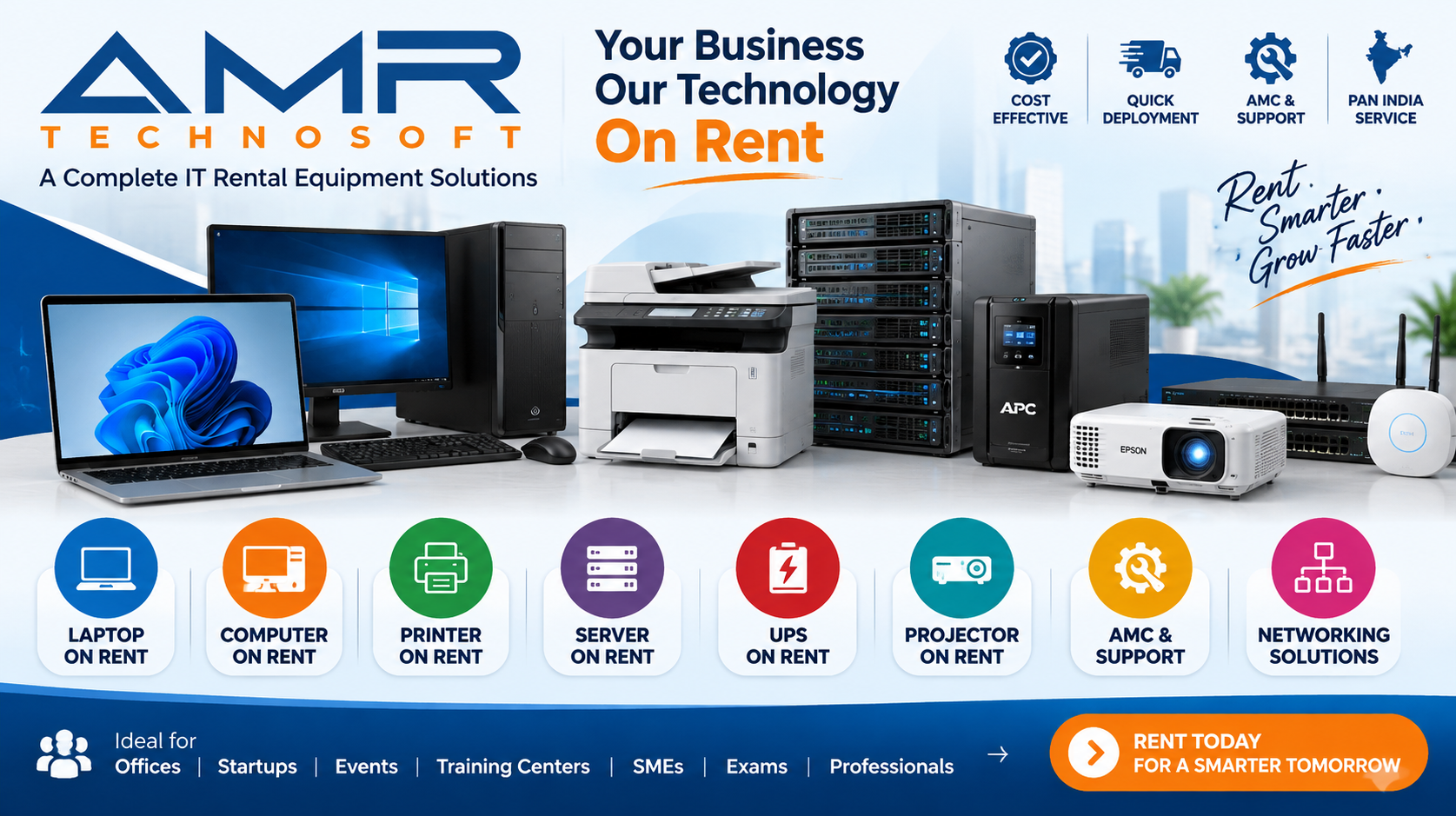
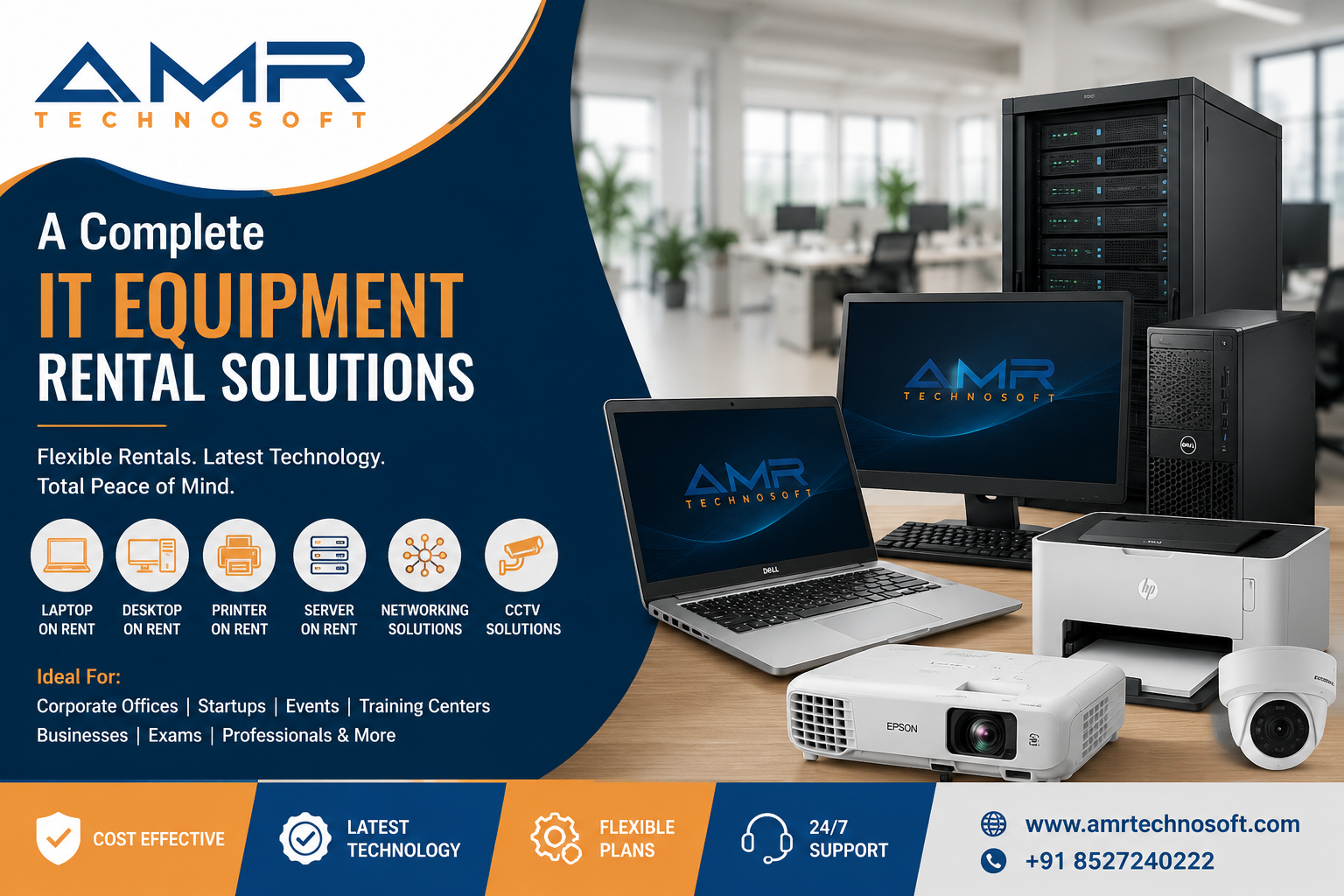
Businesses can rent nearly any IT or office technology imaginable—laptops, desktops, and tablets, along with servers, networking equipment, display screens, projectors, and complete workstation setups—making rental a genuine alternative to ownership across the full technology stack.
The most frequently rented categories through office tech rental services include:
- Laptops and ultrabooks — Business-grade and gaming-spec machines for development, design, and general productivity teams
- Desktops and all-in-ones — For finance, operations, and office-based roles requiring high-performance setups
- Servers and NAS devices — IT infrastructure for data-intensive workloads, without the data center investment
- Networking and security hardware — Routers, switches, firewalls, and access points for office or event setups
- Display screens and projectors — For conference rooms, training facilities, and corporate events
- Printers and multifunction devices — Office-grade solutions without the upfront hardware cost
For companies setting up a complete office environment or equipping a remote workforce, business IT equipment rental through AMR Technosoft means one single vendor relationship covering every device category—simplifying procurement, vendor management, and support.
Why Are Indian Companies Shifting to Tech Rentals?
Indian companies are moving toward tech rentals because the 2026 business landscape rewards agility over asset accumulation, and the economic, operational, and strategic case for renting has become too strong to overlook.
India’s startup ecosystem remains one of the most dynamic globally, with countless companies scaling from 10 to 500 employees in just two to three years. Conventional procurement can’t keep up with that pace. Technology rental solutions give these businesses the operational flexibility they need to move fast.
At the same time, India’s large enterprise sector faces a different kind of pressure: global sustainability mandates and ESG reporting requirements that put responsible hardware disposal squarely on the boardroom agenda. Renting extends the lifecycle of devices through the provider’s asset management practices, cutting down e-waste, and removes the enterprise’s direct burden of end-of-life hardware disposal.
Across both segments, this shift is also fueled by the growing quality and reach of rental providers. Companies like AMR Technosoft now deliver pan-India logistics, fast replacement guarantees, and enterprise-grade service agreements that rival—or exceed—what an internal IT team could offer for owned equipment.
Why Is AMR Technosoft a Leading Tech Rentals Company in India?
AMR Technosoft stands out as a leading Tech Rentals Company in India by combining an extensive range of the latest IT equipment, pan-India logistics, proactive maintenance, and flexible rental plans—all backed by an enterprise-grade service model built around how Indian businesses actually operate in 2026.
Here’s what sets AMR Technosoft apart:
- Extensive Equipment Range: From Laptop Rental and desktop solutions to servers, networking gear, and full office tech setups, AMR Technosoft covers every category of IT and office equipment a business could need.
- Flexible Rental Plans: Short-term options for projects and events, plus long-term contracts for ongoing operations—all structured around operational budgets without locking businesses into rigid terms.
- Fast Pan-India Delivery: Whether a company is onboarding a team in Mumbai, Hyderabad, Chennai, or a Tier 2 city, AMR Technosoft delivers configured, ready-to-use equipment on timelines that match business needs.
- Proactive Maintenance and Rapid Replacement: AMR Technosoft manages maintenance proactively and swaps out faulty equipment quickly, avoiding the kind of downtime that costs businesses far more than any rental fee.
- Predictable, Affordable Pricing: Fixed monthly rates mean no surprise costs, no depreciation write-offs, and straightforward budget forecasting regardless of team size.
- Startup and Enterprise Solutions: AMR Technosoft’s rental models work equally well for a 10-person startup renting five laptops and a 2,000-person enterprise managing a distributed fleet across twelve cities.
- Dedicated Account and Technical Support: Every client gets support from a team that actually understands their infrastructure—not a call center reading from a script.
The result is a technology rental partner that cuts procurement complexity, boosts IT reliability, and gives businesses the hardware foundation they need to stay competitive—without the financial weight of ownership.
The Future Belongs to Businesses That Stay Agile
The trends defining 2026 and beyond all point the same direction: businesses that remain asset-light, technologically current, and operationally flexible will outperform those weighed down by owned hardware.
AI-Driven Workplaces Demand Regular Upgrades
AI co-processors, neural processing units, and on-device machine learning are now standard features in new business hardware. Companies still running three-year-old devices are getting a fraction of the intended performance from their AI productivity tools. Renting lets businesses move to AI-native hardware as it becomes available, keeping teams at peak productivity without needing a full replacement cycle.
Hybrid Work Requires Scalable, Distributed Infrastructure
Hybrid work isn’t a passing trend—it’s the permanent operating model for knowledge workers in 2026. Managing owned hardware across dozens of home offices and multiple company locations creates enormous IT complexity. Scalable IT rental solutions let companies provision, configure, and replace devices across distributed locations through a single vendor relationship, dramatically simplifying infrastructure management.
Sustainability and Reduced E-Waste
Electronic waste is India’s fastest-growing waste category, and regulatory pressure on businesses to prove responsible disposal practices keeps intensifying. When a business rents its technology, the provider handles the device’s full lifecycle—refurbishment, reuse, and responsible recycling included. Companies that rent significantly cut their direct contribution to e-waste while meeting ESG reporting requirements without added operational strain.
In this context, ownership isn’t just financially inefficient—it’s increasingly out of step with where business, regulation, and corporate responsibility are all heading.
Frequently Asked Questions
1. Is renting tech equipment more expensive than buying in the long run? Not when you account for the full cost of ownership. Renting removes upfront capital costs, maintenance expenses, repair bills, hardware replacement cycles, and disposal costs—making the true cost comparison strongly favor rental, especially for equipment used for fewer than five years.
2. Can a small startup afford Laptop Rental services in India? Yes. Laptop Rental services are built to be accessible for small teams. AMR Technosoft offers plans starting from a single device, with monthly pricing well within reach for early-stage companies. Startups can scale their device count up or down as their team grows or shrinks.
3. What happens if rented equipment breaks down or malfunctions? With AMR Technosoft, maintenance and replacement are built into the rental agreement. If a device fails, it’s repaired or replaced—usually within one business day in major cities. That means no downtime liability and no unexpected repair bills for your business.
4. Are tech rentals tax-deductible for Indian businesses? Yes. Rental payments for business equipment are classified as operating expenses (OPEX) under Indian accounting standards and are fully deductible in the financial year incurred—unlike purchased equipment, which must be depreciated over time as a capital asset.
5. How quickly can AMR Technosoft deploy rented tech equipment across multiple cities? AMR Technosoft runs a pan-India logistics network built for rapid deployment across major metros and Tier 2 cities. For standard configurations, equipment is typically delivered and operational within two to three business days of the rental agreement being confirmed.
Conclusion: The Case for Renting Is Closed
The argument for buying tech equipment outright in 2026 gets harder to justify by the day. Depreciation is faster. Technology cycles are shorter. Hybrid work demands a level of flexibility that ownership simply can’t provide. Environmental and regulatory pressure around e-waste keeps mounting. And the financial logic of converting capital expenditure into predictable operating expenses is compelling for any business that values growth over asset accumulation.
Renting tech equipment in 2026 isn’t a temporary fix—it’s a long-term strategic decision that gives businesses the agility to grow, the flexibility to adapt, and the financial clarity to invest where it counts most.
AMR Technosoft exists to make that decision easy. As a trusted Tech Rentals Company in India with deep expertise in IT and office equipment rentals, AMR Technosoft has helped hundreds of startups, SMEs, and enterprises equip their teams with the right technology—on time, on budget, and without the weight of ownership.