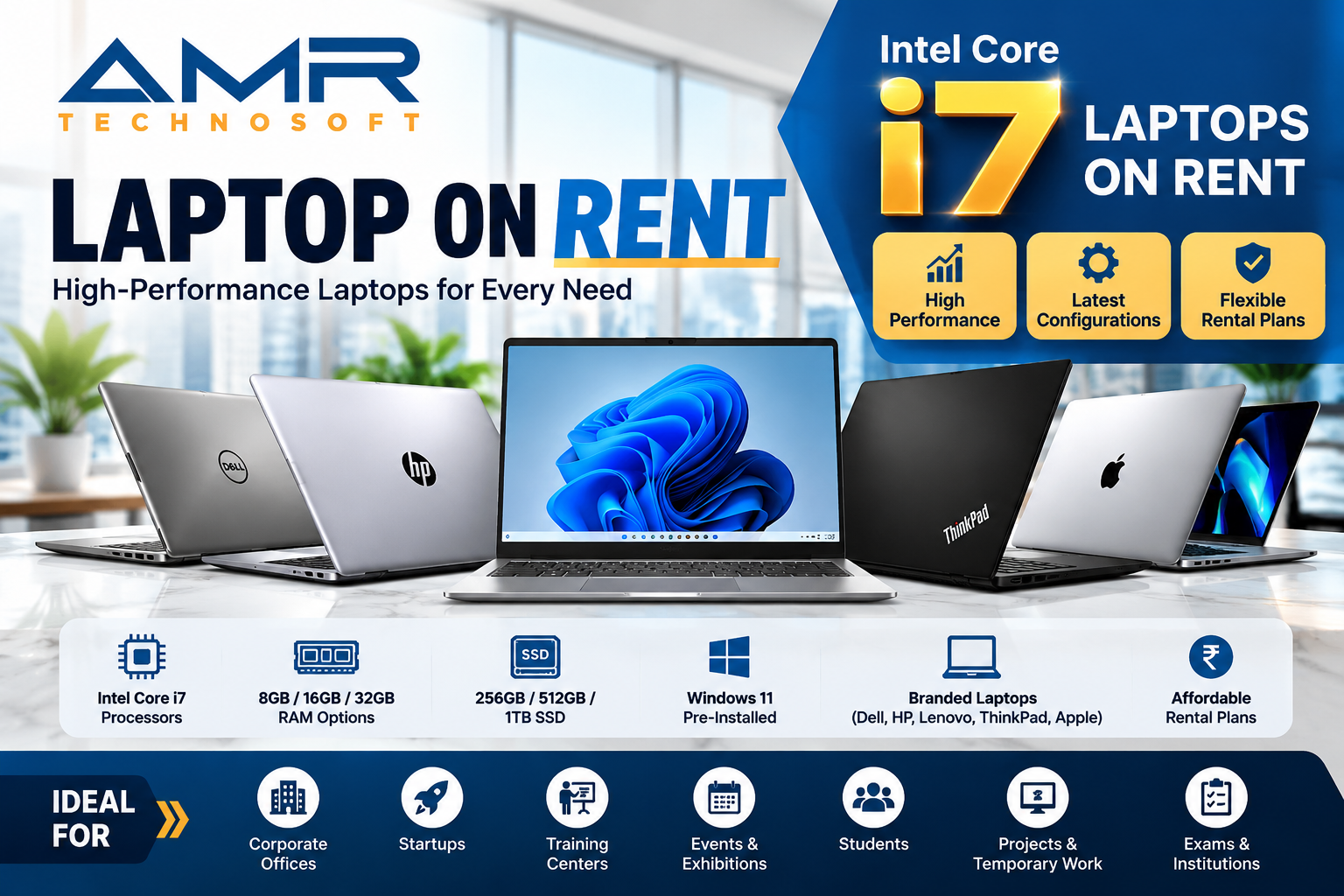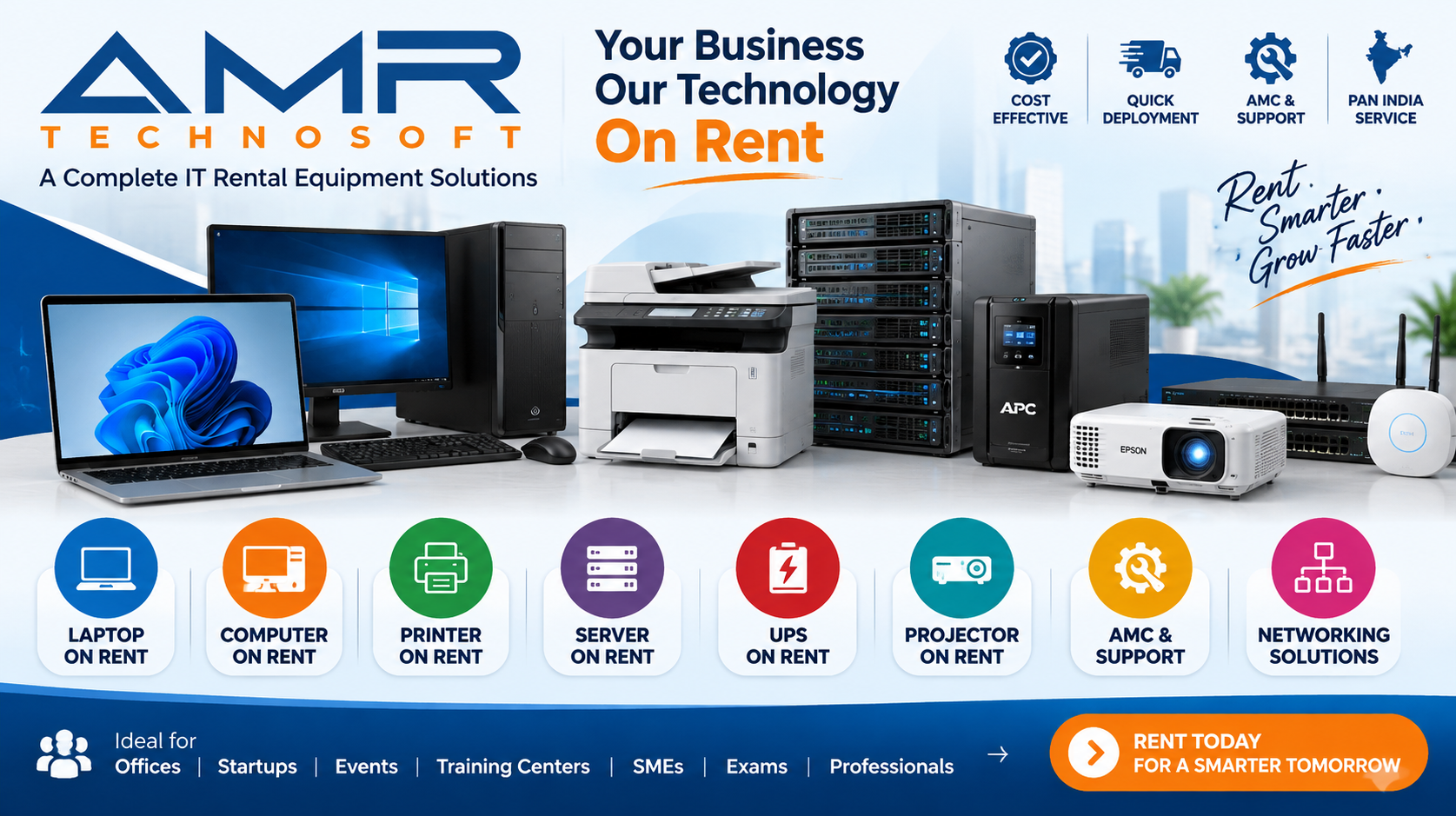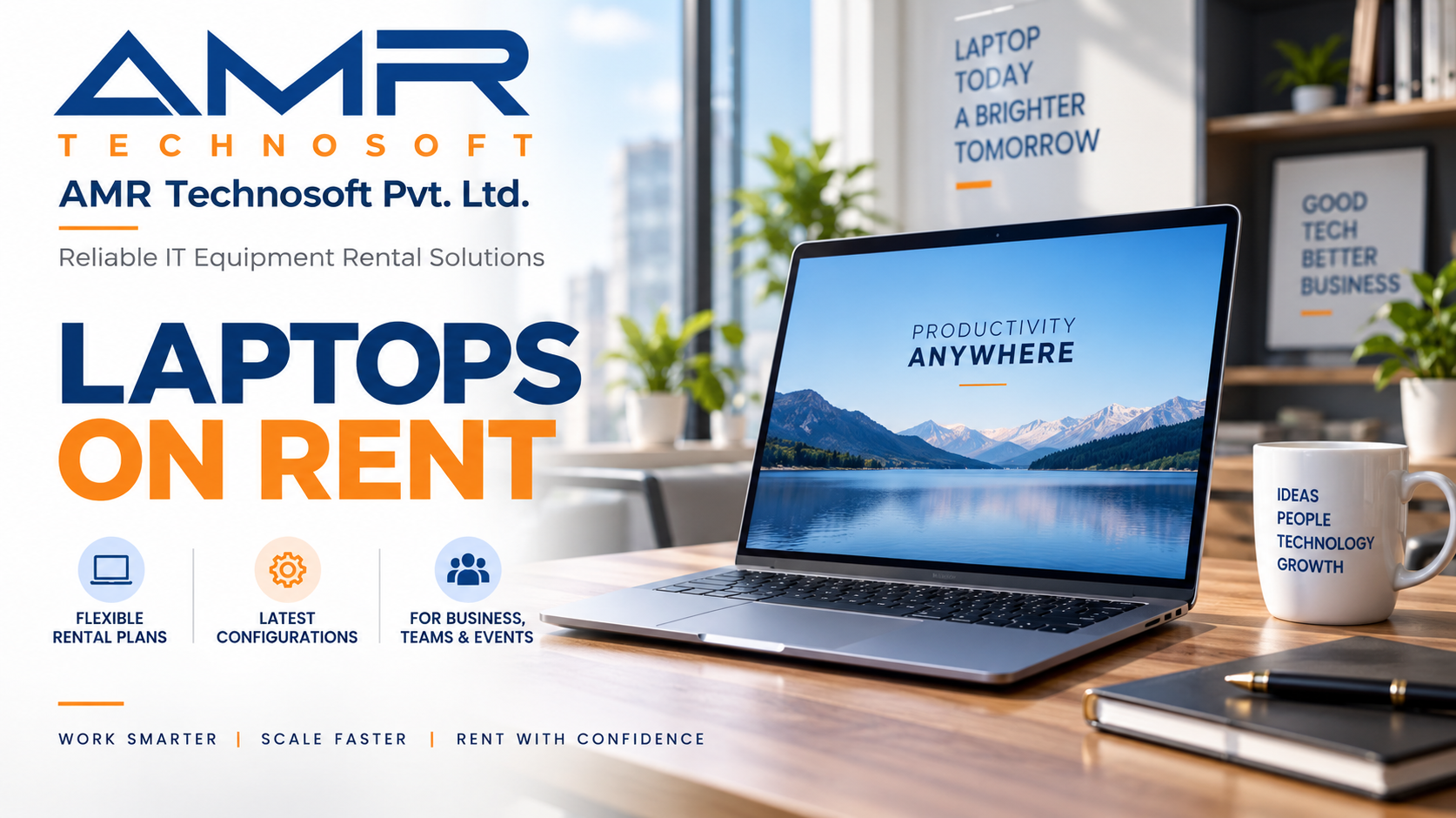
Laptop on rent – AMR Technosoft
AMR Technosoft is Renting a laptop has quietly become one of the smartest financial decisions a person can make. Whether you’re a student juggling online classes, a startup founder scaling a team overnight, a remote worker who needs a backup machine, or someone attending a short-term project or event, laptop rental services offer flexibility that outright purchasing simply can’t match. You get access to the latest hardware without the long-term commitment, the depreciation headache, or the upfront capital drain.
But here’s the catch: not all rental laptops — and not all rental companies — are created equal. Choose poorly, and you could end up with a sluggish machine, hidden fees, a frustrating support experience, or a contract that locks you into terms you didn’t fully understand. Choose wisely, and renting becomes one of the most cost-effective, low-stress ways to stay productive.
This guide walks you through everything you need to know to choose the best laptop on rent — from understanding your actual needs to reading the fine print on a rental agreement. It’s built to stay useful no matter what year you’re reading it in, because the fundamentals of smart laptop renting don’t change even as the hardware does.
Table of Contents
- Why People Rent Laptops Instead of Buying
- Step 1: Understand Your Actual Use Case
- Step 2: Set a Realistic Budget
- Step 3: Know the Specifications That Actually Matter
- Step 4: Research the Rental Company’s Reputation
- Step 5: Compare Rental Plans and Duration Flexibility
- Step 6: Understand the Full Pricing Structure (Watch for Hidden Costs)
- Step 7: Inspect the Condition of the Laptop
- Step 8: Check Warranty, Insurance, and Damage Policies
- Step 9: Evaluate Delivery, Setup, and Pickup Services
- Step 10: Confirm Software and OS Licensing
- Step 11: Read the Rental Agreement Carefully
- Step 12: Test Customer Support Responsiveness
- Step 13: Compare Multiple Providers Before Deciding
- Step 14: Understand the Security Deposit and Refund Process
- Step 15: Check Accessories and Peripherals Included
- Step 16: Look for Upgrade or Exchange Options
- Step 17: Read Genuine Reviews and Testimonials
- Renting vs. Buying: A Practical Comparison
- Laptop Rental Tips for Specific Use Cases
- Common Mistakes to Avoid When Renting a Laptop
- Frequently Asked Questions
- Final Thoughts
1. Why People Rent Laptops Instead of Buying
Before diving into the “how,” it helps to understand the “why.” People turn to laptop rentals for several recurring reasons:
- Short-term needs: A three-month internship, a semester-long course, or a temporary work assignment doesn’t justify a full laptop purchase.
- Budget constraints: Renting spreads cost over time instead of requiring a large upfront payment.
- Access to premium hardware: Renting lets you use a higher-spec machine than you might otherwise afford outright.
- Avoiding depreciation: Laptops lose value fast. Renting sidesteps that loss entirely.
- Business scalability: Companies hiring contractors or scaling teams quickly often rent laptops to equip staff without heavy capital expenditure.
- Testing before committing: Some people rent a laptop model to “try before they buy” before making a long-term purchase decision.
- Event and project-based work: Conferences, film shoots, trade shows, and hackathons often require temporary hardware.
Whatever your reason, the goal is the same: get a reliable machine that fits your needs, without overpaying or getting stuck with a bad deal. That starts with knowing exactly what you need.
2. Step 1: Understand Your Actual Use Case
The single biggest mistake people make when renting a laptop is failing to define what they’ll actually use it for. Renting the wrong specification either wastes money (over-renting) or cripples your productivity (under-renting).
Ask yourself:
- What software will I run daily? Basic browsing and document editing need far less power than video editing, 3D rendering, or software development.
- Will I be multitasking heavily? If you routinely have 20+ browser tabs, several apps, and virtual meetings running simultaneously, you need more RAM and a stronger processor.
- Is portability important? If you’re traveling or commuting, a lightweight ultrabook matters more than raw power.
- Do I need a specific operating system? Some software (certain design tools, enterprise systems, or specialized engineering programs) only runs well on Windows or macOS.
- How long will I need it? A weekend event has very different requirements than a six-month project.
Once you have clarity on your use case, categorize your need into one of these general profiles:
- Basic/Everyday Use: Email, browsing, video calls, document editing, streaming.
- Business/Professional Use: Spreadsheets, presentations, CRM tools, moderate multitasking.
- Creative Use: Video editing, graphic design, photo editing, audio production.
- Technical/Development Use: Coding, running virtual machines, compiling large projects, data analysis.
- Gaming or High-Performance Use: Demanding titles, rendering, simulations.
This single step will guide nearly every other decision on this list, so don’t skip it.
3. Step 2: Set a Realistic Budget
Rental pricing is usually structured around duration — daily, weekly, monthly, or long-term (3, 6, or 12+ months). Before you start comparing providers, decide on a budget range that accounts for:
- The base rental fee for your required specifications
- A refundable security deposit (common with most rental companies)
- Possible delivery or setup charges
- Optional insurance or damage protection add-ons
- Taxes, where applicable
A helpful rule of thumb: the longer the rental period, the lower the effective daily or monthly cost tends to be. Many providers offer discounted rates for 6-month or 12-month commitments compared to month-to-month plans. If you have a reasonable idea of how long you’ll need the laptop, committing to a longer plan can save a meaningful amount of money — just make sure the provider allows early termination without excessive penalties, in case your plans change.
Avoid the temptation to choose the cheapest available option purely on price. A rock-bottom rate on an old, underpowered, or poorly maintained machine can cost you more in lost productivity than you save in rental fees.
4. Step 3: Know the Specifications That Actually Matter
Once your use case and budget are clear, it’s time to translate that into actual hardware specifications. Here’s a breakdown of what each component means for real-world performance:
Processor (CPU)
The CPU is the brain of the laptop. For everyday browsing and office work, a mid-range processor is sufficient. For video editing, coding, or running multiple heavy applications, look for a higher-tier, more recent-generation processor. When comparing options, prioritize newer processor generations over raw clock speed numbers alone, since architecture improvements often matter more than headline numbers.
RAM (Memory)
RAM determines how smoothly your system multitasks.
- 8GB: Adequate for basic browsing and document work, but can feel tight with many tabs or apps open.
- 16GB: A comfortable sweet spot for most professional and student use cases.
- 32GB or more: Recommended for video editing, large datasets, software development, or running virtual machines.
Storage (SSD vs HDD)
Always prioritize a laptop with a Solid-State Drive (SSD) over a traditional Hard Disk Drive (HDD). SSDs are dramatically faster for boot times, file transfers, and application loading. For storage capacity, 256GB is workable for basic use, while 512GB or 1TB is better if you’ll be storing large files, project data, or media.
Display
Screen size and resolution affect both comfort and productivity.
- 13–14 inch screens are ideal for portability.
- 15–16 inch screens offer a better balance for extended work sessions.
- Full HD (1920×1080) is the practical minimum for a sharp, comfortable viewing experience; higher resolutions benefit design and creative work specifically.
Battery Life
If you’ll be working away from a power outlet frequently, ask the rental provider for the laptop’s realistic battery life under normal use (not just the manufacturer’s marketing claim, which is often optimistic).
Build Quality and Weight
If you’re renting for travel or daily commuting, weight and durability matter. Ask whether the chassis is metal or plastic, and how much the unit weighs.
Ports and Connectivity
Check whether the laptop has the ports you actually need — USB-A, USB-C, HDMI, an SD card reader, or Ethernet — especially if you rely on external monitors, hard drives, or peripherals that aren’t wireless.
5. Step 4: Research the Rental Company’s Reputation
The hardware only matters as much as the company standing behind it. A great specification sheet means little if the provider is unreliable, unresponsive, or has a history of poor service.
Here’s how to vet a rental provider properly:
- Check how long they’ve been operating. Established companies with a multi-year track record are generally safer bets than brand-new, unverified operators.
- Look for verifiable customer reviews across independent platforms, not just testimonials curated on their own website.
- Check for business registration and legitimacy. A credible company will have clear business information, a physical or registered address, and transparent contact details.
- Ask about their fleet management. Reputable providers refurbish, sanitize, and test their laptops between rentals rather than shipping them out “as-is.”
- See if they specialize in your need. Some companies focus on corporate bulk rentals, others on individual short-term rentals, and others on high-performance creative or gaming machines. A specialist is often a safer choice than a generalist for niche needs.
A quick way to gauge reliability: contact their support team with a pre-rental question and see how quickly and helpfully they respond. This is often the clearest signal of what you can expect after you’ve paid.
6. Step 5: Compare Rental Plans and Duration Flexibility
Rental providers typically offer multiple plan structures. Understanding these options helps you avoid overpaying or under-committing.
- Daily/Weekly Rentals: Best for short events, conferences, or emergency backup needs.
- Monthly Rentals: Ideal for freelancers, interns, or short-term project work.
- Long-Term Rentals (6–12+ months): Best for ongoing professional or business use, usually at a discounted rate.
- Rent-to-Own Plans: Some providers allow a portion of your rental payments to count toward eventual ownership. This can be worth exploring if you suspect you might want to keep the machine long-term.
Also check:
- Minimum rental duration — some providers require a minimum commitment period.
- Extension policy — can you extend your rental easily if your project runs longer than expected?
- Early return policy — what happens (and what do you pay) if you need to return the laptop before the agreed term ends?
Flexibility matters because needs change. A provider that makes it easy to extend, shorten, or modify your plan is generally more valuable than one offering a slightly lower price but rigid terms. AMR Technosoft is a Best Laptop on rent near me and computer on rent near me service provider in your city. if you want to be compare price for rental services rate compare many of that section if you want to be hire laptop and IT equipment solutions. AMR Technosoft is a leading High integration support service allocation for that section Impression an solution for that time last 16 years leading group of AMR Network and support for that section.
7. Step 6: Understand the Full Pricing Structure (Watch for Hidden Costs)
The advertised rental price is rarely the full story. Before committing, get a complete breakdown of costs, including:
- Base rental fee (daily/weekly/monthly rate)
- Security deposit (usually refundable, but confirm the conditions)
- Delivery and pickup charges
- Setup or configuration fees
- Insurance or damage protection add-ons
- Late return penalties
- Early termination fees
- Taxes and service charges
Ask the provider directly: “What is the total amount I will pay, including all fees, for my exact rental duration?” Get this in writing, ideally via email or a formal quote, so there’s no ambiguity later. Transparent providers will have no issue answering this clearly and quickly; hesitation or vague answers are a red flag.
8. Step 7: Inspect the Condition of the Laptop
Rental laptops are, by definition, used equipment that’s been through multiple rental cycles. That’s not inherently a problem — reputable providers refurbish and test machines thoroughly — but you should still verify condition before accepting delivery.
When the laptop arrives (or before you finalize the rental, if picking it up in person), check:
- Physical condition: Screen for scratches, cracks, or dead pixels; check the keyboard, trackpad, and hinges for wear.
- Battery health: Ask for the battery’s cycle count or health percentage if the provider can share it.
- Performance: Boot up the machine and check for unusual slowness, overheating, or fan noise under light use.
- Ports and peripherals: Test USB ports, the charging port, HDMI output, and the webcam/microphone if you’ll need them.
- Pre-installed software: Confirm the operating system is genuine, activated, and free of unnecessary bloatware or leftover data from a previous renter.
Document the condition with photos or a short video at the time of delivery. This protects you if there’s ever a dispute about pre-existing damage when you return the unit.
9. Step 8: Check Warranty, Insurance, and Damage Policies
Accidents happen — a spilled coffee, a drop, a malfunctioning component. Before renting, understand exactly what happens if something goes wrong.
Key questions to ask:
- Is accidental damage covered, or only manufacturer defects?
- Is there an optional damage protection plan, and what does it cost relative to the risk it covers?
- What is the deductible or liability cap if the laptop is damaged, lost, or stolen?
- How quickly will a malfunctioning unit be replaced? Ask about typical turnaround time for repairs or swaps.
- Is normal wear and tear excluded from damage charges? It should be — you shouldn’t be penalized for reasonable, everyday use.
A provider with a clear, fair damage policy (and ideally an optional insurance add-on) gives you peace of mind and protects you from unexpectedly large charges over something outside your control.
10. Step 9: Evaluate Delivery, Setup, and Pickup Services
Convenience matters, especially if you’re renting for business use or don’t have time to troubleshoot hardware yourself. Look for providers who offer:
- Doorstep delivery with a defined delivery window
- Basic setup assistance, especially for business or bulk rentals
- Scheduled pickup at the end of your rental term, without requiring you to ship the unit yourself
- Real-time tracking for delivery and pickup logistics
- Clear instructions for what to do if the laptop arrives damaged or doesn’t match what was ordered
For corporate or bulk rentals, ask whether the provider can pre-configure machines (installing necessary software, setting up user accounts, applying security policies) before delivery — this can save significant onboarding time for teams.
11. Step 10: Confirm Software and OS Licensing
This step is often overlooked but critically important. Ask the provider directly:
- Is the operating system genuine and properly licensed?
- Are essential productivity tools (like an office suite) pre-installed, or will you need to arrange your own licenses?
- If you need specialized software (design, engineering, or development tools), can the provider pre-install it, or is that your responsibility?
- Will you have administrator access to install software yourself, or is the machine locked down?
Using unlicensed or improperly activated software can create compliance issues, especially for business use, so this is worth confirming explicitly rather than assuming.
12. Step 11: Read the Rental Agreement Carefully
It’s tempting to skim through a rental contract and sign quickly, especially when you’re in a hurry to get set up. Resist that urge. The rental agreement is where the real terms of your relationship with the provider live, and it should clearly cover:
- Rental duration and renewal terms
- Total cost breakdown
- Security deposit terms and refund timeline
- Damage and loss liability
- Late return and early termination penalties
- Data privacy policy (what happens to any data on the device, and what the provider does to wipe previous users’ data)
- Support and replacement guarantees
- Circumstances under which the provider can reclaim the device early
If anything is unclear or feels one-sided, ask for clarification in writing before signing. A trustworthy provider will be transparent and willing to explain every clause.
13. Step 12: Test Customer Support Responsiveness
Support quality often only becomes apparent when something goes wrong — which is exactly the wrong time to discover a provider is unresponsive. Before committing, test their support channels:
- Send a pre-sales question via chat, email, or phone and time their response.
- Ask a slightly technical question (e.g., about specifications or warranty terms) to see how knowledgeable their team is.
- Check if support is available during hours that match your working schedule, especially if you’re in a different time zone than the provider.
- Look for multiple support channels (phone, email, live chat) rather than relying on just one.
Good support responsiveness before you’ve even paid is a strong predictor of how you’ll be treated after.
14. Step 13: Compare Multiple Providers Before Deciding
Never settle on the first rental provider you find. Get quotes from at least three different companies for the same specifications and duration, and compare:
- Total cost (not just the advertised rate)
- Hardware condition and warranty policies
- Delivery timelines
- Contract flexibility
- Customer reviews and reputation
- Support quality
Building a simple comparison table — even a basic one in a notes app — makes it much easier to see which provider actually offers the best overall value, rather than just the lowest sticker price.
15. Step 14: Understand the Security Deposit and Refund Process
Most rental providers require a refundable security deposit to protect against damage, loss, or non-return of the equipment. Before paying, confirm:
- The exact deposit amount
- What conditions must be met for a full refund
- How long the refund takes to process after the laptop is returned
- What deductions (if any) are standard for normal wear and tear versus actual damage
- Whether the deposit is refunded to the original payment method or as store credit
Get this in writing, and keep your payment receipts and the delivery/return condition documentation until your deposit has been fully refunded.
16. Step 15: Check Accessories and Peripherals Included
Depending on your needs, you may require more than just the laptop itself. Confirm whether the following are included, available as add-ons, or your own responsibility:
- Charger and power adapter (and whether it matches your region’s plug type)
- Laptop bag or protective sleeve
- External mouse or keyboard
- Webcam or headset, if not built-in or if higher quality is needed
- Docking station or additional ports, if you need multiple monitor support
Clarifying this upfront avoids last-minute scrambling to buy accessories separately.
17. Step 16: Look for Upgrade or Exchange Options
Needs can change mid-rental — a project might suddenly demand more processing power, or you might realize the screen size isn’t working for you. Ask providers:
- Can I upgrade to a higher-spec machine mid-rental if needed?
- Is there a fee for exchanging a unit that has a hardware issue?
- What is the process and turnaround time for an exchange?
Providers who offer flexible upgrade or exchange options are generally better suited for longer or evolving projects.
18. Step 17: Read Genuine Reviews and Testimonials
Beyond the provider’s own website, look for feedback across independent review platforms, forums, and social media. When reading reviews, pay attention to:
- Recurring complaints (a single bad review is normal; a pattern is a warning sign)
- Comments specifically about hardware condition and reliability
- Feedback on how disputes or damage claims were handled
- Comments about delivery timeliness and support responsiveness
Genuine, detailed reviews — especially ones that mention specific experiences rather than generic praise — are far more useful than star ratings alone.
19. Renting vs. Buying: A Practical Comparison
It’s worth pausing to weigh renting against buying outright, since the right choice depends heavily on your specific situation.
Renting makes more sense when:
- Your need is short-term or project-based
- You want access to higher-spec hardware without a large upfront cost
- You want to avoid the hassle of resale or disposal later
- Your needs might change and you want flexibility to upgrade
- You need to scale a team quickly without heavy capital investment
Buying makes more sense when:
- You’ll need the laptop indefinitely, well beyond a year or two
- You want full control over customization and long-term software installs
- You’ve calculated that cumulative rental costs would exceed the price of ownership over your expected usage period
- You don’t want to deal with return deadlines or provider-specific policies
A simple way to decide: calculate the total rental cost for your realistic usage period (including deposit and fees) and compare it against the purchase price of an equivalent laptop, factoring in resale value if you’d eventually sell it. If the numbers are close, flexibility and lack of long-term commitment often tip the decision toward renting.
20. Laptop Rental Tips for Specific Use Cases
Students
Prioritize a lightweight, portable laptop with solid battery life and enough RAM to handle research, writing, and video calls comfortably. Look for student-specific rental discounts, which many providers offer.
Remote and Hybrid Professionals
Choose a machine with a reliable webcam, good microphone quality, and enough processing power to handle video conferencing alongside other applications without lag. A long-term rental plan usually offers the best value here.
Startups and Growing Teams
Look for providers who offer bulk rental discounts, centralized billing, and the ability to manage multiple devices under one account. Pre-configuration services can significantly speed up onboarding new hires.
Creative Professionals
Prioritize a higher-resolution display with accurate color reproduction, more RAM, and a faster processor or dedicated graphics capability if your work involves video or 3D rendering.
Event and Conference Use
Short-term daily or weekly rentals with fast delivery and pickup are ideal. Confirm the provider can meet tight event timelines, and consider renting slightly more capable hardware than you think you need, since event environments often involve unpredictable demands (presentations, live demos, multiple applications running simultaneously).
Developers and Technical Users
Prioritize higher RAM (16GB minimum, 32GB if running virtual machines or containers), a fast SSD, and confirm whether you’ll have administrator access to install your development environment and tools.
21. Common Mistakes to Avoid When Renting a Laptop
- Choosing based on price alone, without checking specifications or provider reputation.
- Skipping the fine print in the rental agreement.
- Not documenting the laptop’s condition at delivery, which can complicate deposit refunds later.
- Underestimating your actual performance needs, leading to a frustrating, underpowered experience.
- Failing to confirm total costs upfront, then being surprised by delivery, setup, or insurance fees.
- Ignoring customer support quality until something goes wrong.
- Not asking about data privacy and previous user data wipe procedures.
- Committing to a long-term plan without checking early termination flexibility.
Avoiding these pitfalls alone will put you ahead of most renters and significantly improve your overall experience.
22. Frequently Asked Questions
Is renting a laptop cheaper than buying one?
It depends on your usage duration. For short-term needs (a few months to about a year), renting is typically more cost-effective than buying, since you avoid the upfront cost and depreciation loss. For long-term, indefinite use, buying is usually more economical over time.
Can I rent a laptop with specific software pre-installed?
Many providers offer this as an add-on service, especially for business or specialized professional use. Always confirm software licensing and installation policies before finalizing your rental.
What happens if the rented laptop breaks down?
Reputable providers offer a replacement or repair service, often within a defined turnaround window, as part of their standard terms. Confirm this policy — and any associated costs — before renting.
Is my data safe on a rented laptop?
Ask the provider about their data wipe and sanitization process between rentals. A trustworthy provider will have a clear, documented procedure to ensure no previous user’s data remains on the device, and you should also take your own precautions, such as avoiding storing sensitive files locally without backup and encryption.
Do I need to buy insurance for a rented laptop?
It depends on the provider’s default damage policy and your own risk tolerance. If accidental damage isn’t covered by default, an optional insurance add-on is often a worthwhile, low-cost way to avoid a large unexpected charge.
Can I extend my rental period if I need the laptop longer than planned?
Most providers allow extensions, though it’s best to request this before your current term ends to avoid late fees or availability issues. Confirm the extension process when you first sign up.
What specifications should I choose if I don’t know exactly what I’ll be doing?
When in doubt, a mid-range configuration — a recent-generation processor, at least 16GB RAM, and an SSD — offers a comfortable buffer for most general and moderately demanding tasks without overpaying for unnecessary power.
23. Conclusion:
Choosing the best laptop on rent isn’t about finding the cheapest listing or the flashiest specs — it’s about matching the right hardware, the right provider, and the right terms to your actual needs. Take the time to define your use case, set a realistic budget, vet the provider’s reputation, understand the full cost structure, and read the agreement carefully before signing.
Do that groundwork once, and renting becomes exactly what it should be: a flexible, low-risk, cost-effective way to get the technology you need, exactly when you need it, without the long-term baggage of ownership.